
-->
American Resources Policy Network
Promoting the development of American mineral resources.
  • International automakers take steps to secure access to critical minerals

    While not making a big splash in the media, a piece of news from Germany once more underscores the relevance of critical minerals and associated supply issues.

    As the newly launched German Resource Alliance (Rohstoffallianz) has announced, automakers BMW and VW are officially becoming shareholders of the alliance. Founded in 2012, the Resource Alliance is a “globally active profit-oriented raw materials corporation” which has the backing of the German government, and brings together “companies in Germany with high-level industrial value creation, which have their own need for raw materials.”

    BMW and VW are joining ten other companies, among them Copper producer Arubis, chemical companies BASF, Bayer, Evonik and Wacker Chemie, as well as Bosch, Georgsmarienhuette Holding, Rockwood Lithium, Stahl Holding Saar, and ThyssemKrupp.

    Primary targeted areas of action for the alliance are: providing a communications platform, developing strategies for securing the raw material supply, lobbying and exchange of information, sharing mining know-how and market expertise, project financing and insurance, as well as project management.

    Automakers require significant amounts of critical minerals such as Rare Earths Elements and Copper for vehicle manufacturing. Copper, in particular, is significant as a stand-alone metal and as a “Gateway Metal” that unlocks other “Tech Metals” such as Molybdenum and Selenium.
  • DoE social media event elaborates on agency’s new critical minerals research hub

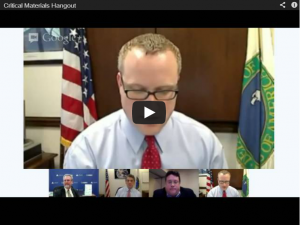
    Earlier this week, the Department of Energy hosted a social media web event, or “Hangout,” to provide further details on its latest research effort to “address supply disruptions for rare earths and other critical materials” at Ames Laboratory.

    During the event, David Sandalow, DoE’s Assistant Secretary for Policy and International Affairs, and Alex King, the new director of the Critical Materials Hub and current director of the Ames Lab, shared details on the objectives and strategy of the new project and answered questions from the audience on Twitter and Facebook. They were joined by Steven Duclos from GE Global Research representing the industry partners with whom the research center will cooperate closely.

    Some of the key points brought up during the events were the following:

      • DoE has acknowledged the challenges associated with China’s near total supply monopoly when it comes to Rare Earths, and the new Hub is the result of a new and more systematic approach to this issue.
      • The Hub will strive to find solutions for the entire life cycle of critical materials – meaning that it will look for points in a material’s life cycle that is amenable to a “nudge” from new technology and new science.
      • The biggest research priorities for the new center are:
        • To make mining viable, no matter what the cost profile looks like to create greater diversity of supply.
        • Finding substitutes
        • Reduce demand by increasing efficiency by which we use REEs in the manufacturing and recycling processes
        • Economic analysis and forecasting, as identifying what will become critical will give head-start to enable other parts of strategy to take hold and help avoid price spikes.
      • While ocean bed mining is something to watch, near-term efforts should focus on land masses.
      • Creating “alternative” materials remains challenging, as in order to avoid redesigns in manufacturing processes you want exactly the same properties without using the same materials.
      • “Recycling” must also focus on the early stages of the manufacturing process, as many byproducts are not efficiently used (for more on byproducts see our Gateway Metals study).

    According to Alex King, “there are materials where no matter how much money [you have] you might not be able to buy what you need.”

    You can watch the full event on DoE’s Youtube channel.

  • DoE awards funding for new Critical Materials Institute (CMI) at Ames Laboratory

    The U.S. Department of Energy (DoE) is stepping up its research efforts in the field of critical and strategic materials. As announced on January 9, the Department is funding the establishment of an “Energy Innovation Hub” through Ames Laboratory in Ames, Iowa. Named the Critical Materials Institute (CMI), the new research center will “bring together (…) more

  • House Oversight Committee threatens use of subpoena powers in case of the EPA’s Bristol Bay Watershed assessment

    As the Daily Caller reports, the House Committee on Oversight & Government Reform is stepping up the pressure on the U.S. Environmental Protection Agency (EPA) in the context of the agency’s controversial negative review of a potential mining project in Alaska’s Bristol Bay area. Reiterating a request made in May of 2012, when the EPA (…) more

  • Domestic resource development and solid manufacturing key to resurgent U.S. economy

    In a comprehensive piece for Resource Investor, Aheadoftheherd.com host and Northern Venture Group President Rick Mills discusses the issue of the United States’ overreliance on foreign mineral imports in the context of steep increases in mineral commodity demand and prices. We at the American Resources Policy Network were thrilled to see him reference our study (…) more

  • The OPEC of Rare Earths – China’s Resource Stranglehold and its National Security Implications

    In his latest column for Real Clear World, American Resources Principal Daniel McGroarty zeros in on China’s dominance of the Rare Earths market. Invoking lopsided production numbers – in spite of international efforts to develop Rare Earths outside of China, China’s supply monopoly still hovers at 95 percent – McGroarty likens China’s REE control to (…) more

  • New Year’s Resolutions for U.S. Policymakers (Part 3)

    This is part three of American Resources’ three-part 2012 retrospective. Check out parts one here and two. Traditionally, the New Year is the time when people reflect on the past twelve months and formulate resolutions for the months ahead. As the first hours of 2013 have been dominated by the drama the Fiscal Cliff, our (…) more

  • New Year’s Resolutions for U.S. Policymakers (Part 2)

    Below is part two of American Resources’ three-part 2012 retrospective. Check out part one here. Traditionally, the New Year is the time when people reflect on the past twelve months and formulate resolutions for the months ahead. As the first hours of 2013 have been dominated by the drama the Fiscal Cliff, our Federal lawmakers (…) more

  • New Year’s Resolutions for U.S. Policymakers (Part 1)

    Traditionally, the New Year is the time when people reflect on the past twelve months and formulate resolutions for the months ahead. As the first hours of 2013 have been dominated by the drama the Fiscal Cliff, our Federal lawmakers may not have gotten around to focusing on other less publicized — but no less (…) more

  • German government agency emphasizes domestic resources

    In its Energy Study 2012, the German Mineral Resources Agency (DERA) emphasizes the importance of using domestic raw materials against the backdrop of increased price volatility and supply risk. As summarized by the German daily Handelsblatt, the agency’s core message is as follows (rough translation): Supply shortages are likely to occur not due to due (…) more

Archives