
-->
American Resources Policy Network
Promoting the development of American mineral resources.
  • House Armed Services Committee’s Bipartisan Defense Critical Supply Chain Task Force Releases Findings and Recommendations

    On the heels of the recently-released White House 100-Day Supply Chain report, momentum to strengthen U.S. supply chains is building.

    On July 22, 2021 the House Armed Services Committee’s bipartisan Defense Critical Supply Chain Task Force, chartered in March of 2021 to “review the industrial base supply chain to identify and analyze threats and vulnerabilities,” released its final report, which includes key findings and policy recommendations.

    Co-chaired by Reps. Elissa Slotkin (D-Mich.) and Mike Gallagher (R-Wis.), the task force convened a series of round tables with with experts and stakeholders to identify

    “1) the processes by which DOD analyzes supply chain vulnerabilities and develops mitigation strategies; 

    (2) DOD’s processes to prioritize and mitigate identified vulnerabilities; and 

    (3) the steps Congress and others can take to help build resilience against future shocks to the supply chain, both in the near term with respect to selected cases, and over the longer term, leveraging the lessons learned from the initial actions.”

    The report includes six legislative recommendations task force members will submit as amendments for the Fiscal Year 2022 National Defense Authorization Act (NDAA) full committee mark up.

    Among them, most notably from an ARPN perspective, were the following:

    “DOD must treat supply chain security as a defense strategic priority. Although DOD conducts assessments for critical supplies and is required by section 2509 of title 10, United States Code, to establish a framework to mitigate risk in the acquisition process, it lacks a comprehensive strategy for the entire supply chain across the Department and the services. The Task Force recommends a statutory requirement for a Department-wide risk assessment strategy and system for continuous monitoring, assessing, and mitigating risk in the defense supply chain.  

    DOD (and the United States more broadly) needs to reduce reliance on adversaries for resources and manufacturing. The defense supply chain presents a national security risk: a significant amount of material in the Defense Industrial Base is sole-sourced from the People’s Republic of China. With the requirement for a strategic framework and illuminating the supply chain, the Department must use this information to work with industry, allies, and partner nations to lessen the reliance on the People’s Republic of China. The Task Force recommends a statutory requirement to identify supplies and materials for major end items that come from adversarial nations and implement a plan to reduce reliance on those nations.

    DOD should strengthen the ability to leverage close ally and partner capabilities through the National Technology and Industrial Base (NTIB). The NTIB is an underutilized forum and should be leveraged to shape policy and partnerships with allies. To reduce reliance on adversaries and expand partnerships, the NTIB will need to help shape global policy. The Task Force recommends updating statutory authority to emphasize the value of a broad collaboration with the NTIB allies beyond acquisition, to strengthen the alliance; directing the NTIB Council to identify particular policies and regulations that could be expanded to the NTIB allies, in order to use the NTIB as a test bed for closer international cooperation and supply chain resiliency; and authorizing an NTIB “International Council” to harmonize industrial base and supply chain security policies. The NTIB countries and other close allies and partners undoubtedly face similar challenges with over-reliance on Chinese and Russian suppliers. Effective policy to reduce the associated supply chain vulnerabilities requires meaningful, sustained dialogue and collaboration. Accordingly, the Task Force encourages the Department’s leaders to prioritize supply chain security policy in bilateral and multilateral discussions. 

    DOD should deploy the full range of American innovation to secure the supply chains involving rare earth elements. This includes diversifying the source of rare earths, minimizing dependence on sources and processes in the People’s Republic of China, seeking global solutions by seeking agreements and collaboration with allies and partners, and increasing relevant capability in the United States. Developing alternative technologies and methods for extraction, processing, and recycling in support of diversification is critical. The Task Force notes research and development is funded by the Department of Energy and Department of Interior and recommends a requirement for the Secretary of Defense to coordinate with both the Secretaries of Energy and Interior to ensure research and development includes the DOD’s interest.”

    The Task Force stresses the common ground between their own findings and recommendations and those included in the Administration’s 100-Day Supply Chain report, including improved communication between stakeholders, and leveraging cooperation with allies and partners, in particular in the framework of the NTIB. From the task force report:

    “Where on-shoring is not feasible or not advantageous, the authors encourage resilience through ‘ally and friend-shoring,’ a construct the Task Force Members endorse. The United States can expand the capacity and capability of the domestic DIB.”

    Against mounting pressures, there is hope that the House task force report, coupled with the findings of the White House’s 100-Day Supply Chain report, will create sufficient momentum to translate recommendations into actual policy, programs and projects to address the nation’s deep shortfalls in Critical Mineral supply.

    The full task force report – including detailed findings and recommendations – can be found here.

    And for a handy compilation of our recent coverage of the 100-Day Supply Chain report, click here.

    Share
  • The Mineral Intensity of a Carbon-Neutral Future – A Look at Copper

    Amidst the global push towards carbon neutrality, “Critical Minerals” has become a buzzword.  As the green energy transition has gone mainstream and electric vehicles and renewable energy sources dominate the news cycle, so has talk about growing demand for some of the specialized materials underpinning this shift — most notably the Rare Earths, and the battery tech metals Lithium, Cobalt, Graphite and Nickel.   A little lost in the media shuffle, though no less important, is Copper — perhaps the unsung hero of the green energy transition.

    Less flashy and headline-grabbing than some of its tech metal peers, this mainstay mineral deserves far more credit and attention than it is currently getting.  Followers of ARPN will know that we have long touted the versatility, stemming from its traditional uses, new applications and Gateway Metal status.

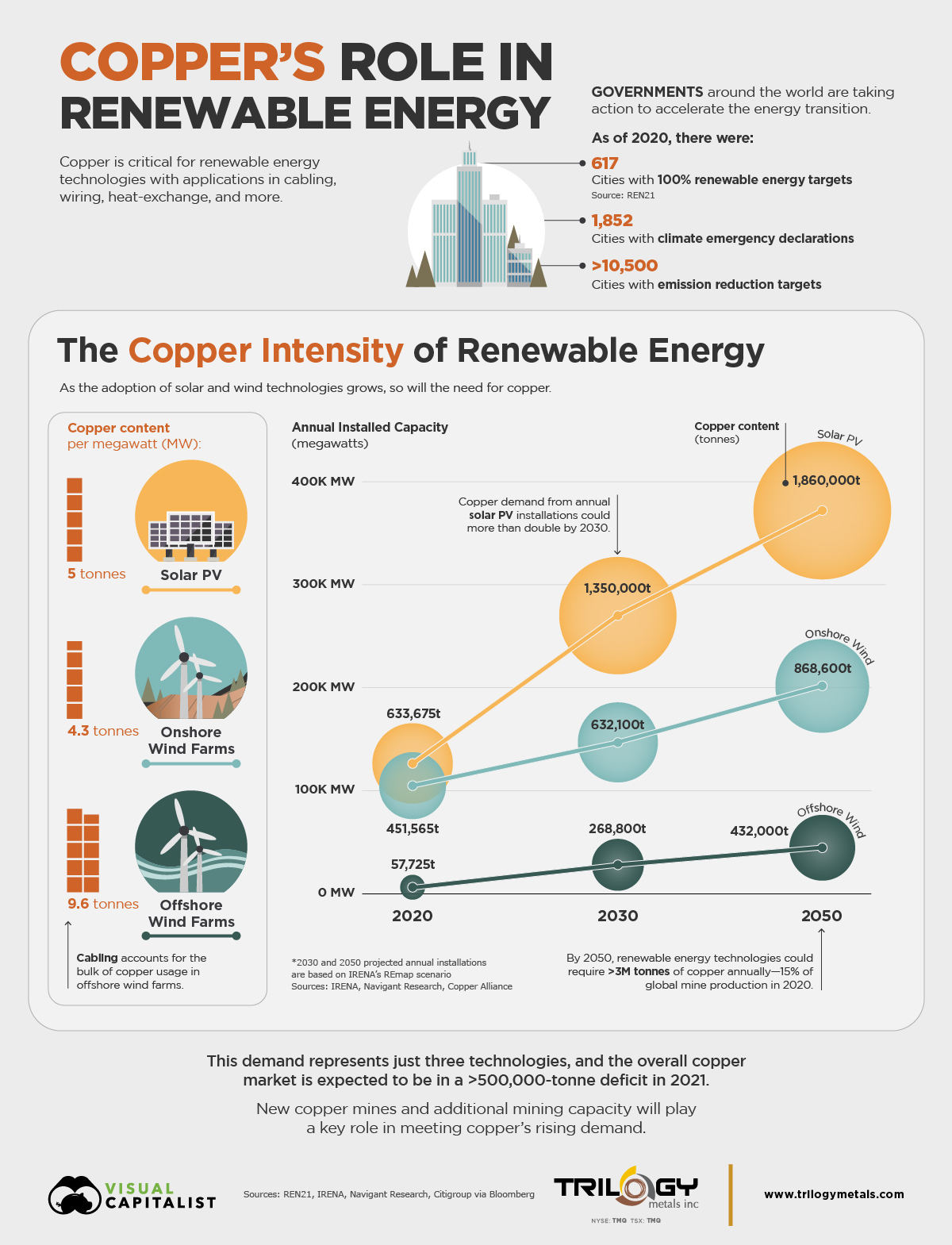
    Copper is also an irreplaceable component for advanced energy technology, ranging from EVs over wind turbines and solar panels to the electric grid.   The manufacturing process for EVs requires four times more Copper than gas powered vehicles, and the expansion of electricity networks will lead to more than doubled Copper demand for grid lines, according to the IEA.

    A recent graphic by Visual Capitalist depicts the Copper intensity of the energy transition with a view towards solar and onshore and offshore wind energy technology:

    8908AEEC-CEA8-4575-91C2-598C427FF705
    Add in Copper’s Gateway Metal status — the processing of the metal yields access to a host of co-products essential to “manufacturing the advanced technologies that will power our economy for generations to come”  such as Cobalt, Tellurium, Molybdenum, Rhenium, Arsenic and REEs  — and a 2019 mining executive’s projection that “[t]he world will need the same amount of copper over the next 25 years that it has produced in the past 500 years if it is to meet global demand.

    Recent developments in Washington, D.C. — movement on a bipartisan infrastructure package and announcements of new EV goals and fuel efficiency standards — will only add to the outlined Copper demand scenarios.

    And the challenge is not just mining, but also processing, as Laura Skaer, a member of the board of directors of the Women’s Mining Coalition and former director of the American Exploration & Mining Association, outlined in a recent piece for Morning Consult:

    “Last year, the United States imported 37 percent of the copper we used. China already refines 50 percent of the world’s copper and the United States only refines about 3 percent. National security experts have warned that relying on China for critical supply-chain materials like refined copper poses a serious threat to America’s national security interests.”

    The United States Government failed in 2018 to include Copper in its official Critical Minerals list, a faux pas the Canadian government did not commit with the release of its own Critical Minerals list earlier this year, which included Copper along with fellow key Gateway Metals Nickel and Zinc in its list of 31.

    Meanwhile, the Biden Administration’s 100-Day Supply Chain Review highlights Copper as an integral component of Lithium-ion battery technology, in the context of being what we have called a “gateway metal” to other critical materials, and for its “use across many end-use applications aside from lithium-ion cells, including building construction, electrical and electronic products, transportation equipment, consumer and general products, and industrial machinery and equipment.” 

    Here’s hoping that the greater prominence given to Copper — both as a standalone material and Gateway Metal — by the White House 100-day report is an indication that a forthcoming updated U.S. Critical Minerals List will acknowledge the metal’s ever-growing importance.  Until then, Copper will remain one of the most “Critical Non-Criticals,” as we note in ARPN’s recent report, Critical Mass.

    Share
  • Critical Mass: ARPN Commentary on the White House 100-Day Supply Chain Report & the Importance of Critical Minerals to the U.S. Technology Base

    After years of inertia, the Critical Minerals space has seen a lot of activity lately. While the coronavirus pandemic has exposed significant supply chain vulnerabilities and critical mineral resource dependencies, recent studies have highlighted the mineral intensity of the global pursuit of a low carbon energy future. This week’s developments in Washington — movement on [...]
  • “Supply Chain” Begins With “Supply:” Department of Commerce 100-Day Report Chapter on Complex Semiconductor Supply Chain

    Current news coverage may have you believe that when it comes to critical minerals, all we’re talking about is Rare Earths and battery tech metals, such as Lithium, Cobalt, Manganese, Nickel and Graphite. However, while certainly extremely important for 21st Century technology, these materials and the sectors in which they find key applications only represent [...]
  • 100 Day Supply Chain Report Inspires New Developments in Critical Minerals Realm

    Released at the beginning of June, the White House’s 100 Day Supply Chain report assessed risks and vulnerabilities in the supply chains for four key industrial sectors, making recommendations on how to alleviate them appears to have already inspired several new developments in the critical minerals realm: As the Australian Financial Review’s U.S. correspondent Matthew [...]
  • Caught in the “Green Dilemma” of Securing Critical Mineral Resource Supply Chains

    A few months ago, when the Biden Administration stepped up its efforts to promote its ambitious renewable energy agenda, Forbes analyst David Blackmon suggested that we might be about to “witness a replay of the politics of the Shale Revolution, only this time those politics will be playing out around the mining of the country’s [...]
  • Close Allies Map Critical Mineral Cooperation

    “Do I have to draw you a map?” As idioms go, that phrase is much nicer than the message it intends – but it’s apt for a new exercise linking the collective expertise of the geological surveys of Australia, Canada and the U.S.: an interactive world map of deposits of rare earths and other critical [...]
  • DoD Chapter of 100-Day Supply Chain Report Acknowledges Gateway/Co-product Challenge

    Friends of ARPN will know that “much of our work is grounded in a conviction that the Technology Age is driven by a revolution in materials science – a rapidly accelerating effort that is unlocking the potential of scores of metals and minerals long known but seldom utilized in our tools and technologies.” In this [...]
  • Independence Day 2021 — Towards Greater Mineral Resource Independence?

    After a long wait — with many parades and fireworks honor the men and women who have fought for, and continue to safeguard our freedoms canceled last year because of the coronavirus pandemic — Independence Day 2021 is upon us. With many of the pandemic-related restrictions lifted, celebrating our freedoms this year feels a little [...]
  • Report from The Yukon: Critical Minerals Challenge Brings “Geopolitical Backwater” Into Focus

    As we outlined in our last post, the Biden Administration’s strategy to secure critical mineral supply chains, as outlined in its just-released 100 Day Supply Chain Report, embraces an “all of the above approach.” While strengthening sustainable mining and processing domestically, the Administration will also rely on partnerships with our closest allies — and of [...]

Archives