
-->
American Resources Policy Network
Promoting the development of American mineral resources.
  • The Mineral Intensity of a Carbon-Neutral Future – A Look at Copper

    Amidst the global push towards carbon neutrality, “Critical Minerals” has become a buzzword.  As the green energy transition has gone mainstream and electric vehicles and renewable energy sources dominate the news cycle, so has talk about growing demand for some of the specialized materials underpinning this shift — most notably the Rare Earths, and the battery tech metals Lithium, Cobalt, Graphite and Nickel.   A little lost in the media shuffle, though no less important, is Copper — perhaps the unsung hero of the green energy transition.

    Less flashy and headline-grabbing than some of its tech metal peers, this mainstay mineral deserves far more credit and attention than it is currently getting.  Followers of ARPN will know that we have long touted the versatility, stemming from its traditional uses, new applications and Gateway Metal status.

    Copper is also an irreplaceable component for advanced energy technology, ranging from EVs over wind turbines and solar panels to the electric grid.   The manufacturing process for EVs requires four times more Copper than gas powered vehicles, and the expansion of electricity networks will lead to more than doubled Copper demand for grid lines, according to the IEA.

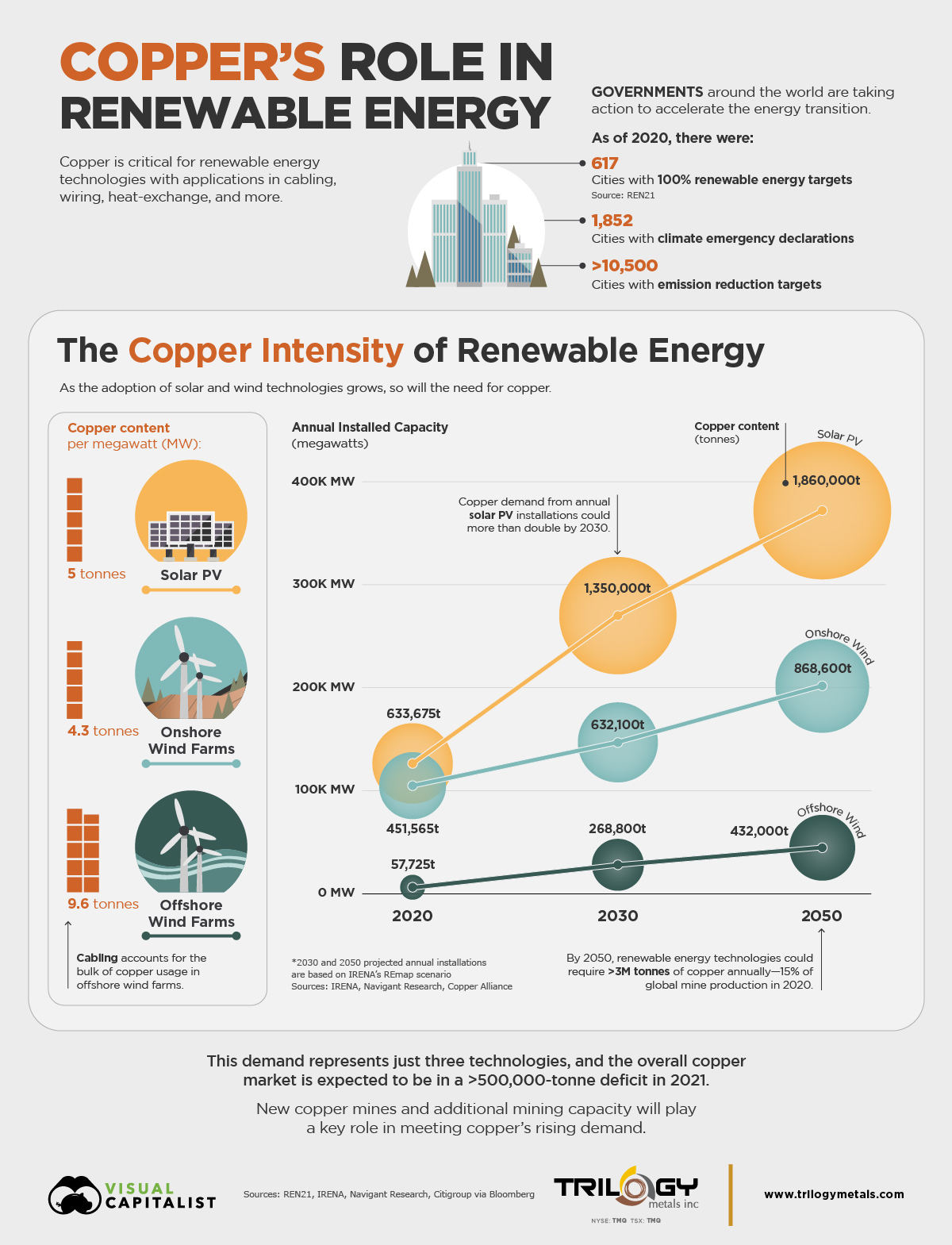
    A recent graphic by Visual Capitalist depicts the Copper intensity of the energy transition with a view towards solar and onshore and offshore wind energy technology:
    8908AEEC-CEA8-4575-91C2-598C427FF705
    Add in Copper’s Gateway Metal status — the processing of the metal yields access to a host of co-products essential to “manufacturing the advanced technologies that will power our economy for generations to come”  such as Cobalt, Tellurium, Molybdenum, Rhenium, Arsenic and REEs  — and a 2019 mining executive’s projection that “[t]he world will need the same amount of copper over the next 25 years that it has produced in the past 500 years if it is to meet global demand.

    Recent developments in Washington, D.C. — movement on a bipartisan infrastructure package and announcements of new EV goals and fuel efficiency standards — will only add to the outlined Copper demand scenarios.

    And the challenge is not just mining, but also processing, as Laura Skaer, a member of the board of directors of the Women’s Mining Coalition and former director of the American Exploration & Mining Association, outlined in a recent piece for Morning Consult:

    “Last year, the United States imported 37 percent of the copper we used. China already refines 50 percent of the world’s copper and the United States only refines about 3 percent. National security experts have warned that relying on China for critical supply-chain materials like refined copper poses a serious threat to America’s national security interests.”

    The United States Government failed in 2018 to include Copper in its official Critical Minerals list, a faux pas the Canadian government did not commit with the release of its own Critical Minerals list earlier this year, which included Copper along with fellow key Gateway Metals Nickel and Zinc in its list of 31.

    Meanwhile, the Biden Administration’s 100-Day Supply Chain Review highlights Copper as an integral component of Lithium-ion battery technology, in the context of being what we have called a “gateway metal” to other critical materials, and for its “use across many end-use applications aside from lithium-ion cells, including building construction, electrical and electronic products, transportation equipment, consumer and general products, and industrial machinery and equipment.” 

    Here’s hoping that the greater prominence given to Copper — both as a standalone material and Gateway Metal — by the White House 100-day report is an indication that a forthcoming updated U.S. Critical Minerals List will acknowledge the metal’s ever-growing importance.  Until then, Copper will remain one of the most “Critical Non-Criticals,” as we note in ARPN’s recent report, Critical Mass.

    Share
  • “Supply Chain” Begins With “Supply:” Department of Commerce 100-Day Report Chapter on Complex Semiconductor Supply Chain

    Current news coverage may have you believe that when it comes to critical minerals, all we’re talking about is Rare Earths and battery tech metals, such as Lithium, Cobalt, Manganese, Nickel and Graphite. However, while certainly extremely important for 21st Century technology, these materials and the sectors in which they find key applications only represent the tip of the proverbial iceberg when it comes to securing critical mineral supply chains.

    In its 100 Day Supply Chain Report, the Biden Administration dedicated an entire chapter to the supply chains of semiconductors — for good reason.

    Semiconductors have become indispensable components for a broad range of electronic devices, and their importance cannot be overstated. The Department of Commerce-led chapter in the report cites the transformational impact of the colloquial computer chip as the launching point of its review:

    “Semiconductors are the material basis for integrated circuits that are essential to modern day life and are used by the typical consumer on a daily, if not hourly, basis. The semiconductor-based integrated circuit is the ‘DNA’ of technology and has transformed essentially all segments of the economy, from agriculture and transportation to healthcare, telecommunications, and the Internet.

    (…)

    In addition to the central role they play in the U.S. economy, semiconductors are essential to national security. Semiconductors enable the development and fielding of advanced weapons systems and control the operation of the nation’s critical infrastructure. They are fundamental to the operation of virtually every military system, including communications and navigations systems and complex weapons systems such as those found in the F-35 Joint Strike Fighter. They are key to the ‘must-win’ technologies of the future, including artificial intelligence and 5G, which will be essential to achieving the goal of a ‘dynamic, inclusive and innovative national economy’ identified as a critical American advantage in the March 2021 Interim National Security Strategic Guidance.”

    According to the report, the supply chains for these highly specialized hi-tech components are extremely complex, as the manufacturing of semiconductors “requires hundreds of essential inputs, many of which are raw materials, chemicals, and gases. These materials have their own complex supply chains, and likely contain hidden choke points that could disrupt production.”

    The manufacturing of semiconductors begins with polysilicon, for which the U.S. currently has some production capacity. However, according to the Department of Commerce, “U.S. technological leadership and production of semiconductor-grade polysilicon is at risk due to China’s actions to increase its dominance of both the semiconductor and solar supply chains.” That risk is further heightened now that China is under U.S. import sanctions for producing polysilicon using forced labor in the Province of Xinjiang. U.S. companies importing Chinese products containing polysilicon from Xinjiang risk having those products impounded at American ports by U.S. Customs and Border Protection.

    Two other key semiconductor materials are Gallium and Indium — for both of which the United States is 100% import reliant, both of which made the 2018 official U.S. Critical Minerals List released by the Department of the Interior, and both of which are primarily sourced from China.

    Due to the extremely complex and geographically dispersed nature of the semiconductor supply chain (which results in the typical semiconductor production process spanning multiple countries and products crossing international borders up to 70 times according to the Department of Commerce), there are many access points for supply chain vulnerabilities along the way.

    To address the semiconductor supply chain challenge, the Biden Administration seeks to “bolster its partnership with the private sector in domestic semiconductor manufacturing and R&D,” and “strengthen engagement with allies and partners to promote fair semiconductor chip allocations, increase production, and promote increased investment.”

    However, let’s be clear: As ARPN’s Daniel McGroarty pointed out last year against the backdrop of excitement over the recent announcement of Arizona as the site for Taiwan Semiconductor’s new next-gen semiconductor factory to manufacture their new 5-nanometer (5nm) chips: “the first word in supply chain is ‘supply.’”

    As the Biden Administration begins to tackle the complex semiconductor supply chain challenge in the context of its “all of the above” approach to decouple from adversary nations, it must begin at the beginning.

    Thankfully, the U.S. is not only in the fortunate position to have known resources for both Gallium and Indium (in Texas and Alaska, respectively), both metals can also be “unlocked” in the “co-product” development of their Gateway Metals Aluminum (for Gallium) and Zinc and Tin (Indium) — another reason stakeholders should focus more on the inter-relationship between Gateway Metals and the critical co-products they unlock.

    Share
  • 100 Day Supply Chain Report Inspires New Developments in Critical Minerals Realm

    Released at the beginning of June, the White House’s 100 Day Supply Chain report assessed risks and vulnerabilities in the supply chains for four key industrial sectors, making recommendations on how to alleviate them appears to have already inspired several new developments in the critical minerals realm: As the Australian Financial Review’s U.S. correspondent Matthew [...]
  • Copper, Lithium, Antimony and Tellurium: Minerals Make Life Features Four Minerals as “Key to an Advanced Energy Future”

    As the number of countries pledging to reach net-zero carbon emissions by the middle of this century (or soon thereafter) continues to grow, and governments and other stakeholders work to transform the energy systems underpinning our economies, demand for critical metals and minerals is soaring. The rapidly-accelerating adoption of EV battery technology, along with plans [...]
  • Close Allies Map Critical Mineral Cooperation

    “Do I have to draw you a map?” As idioms go, that phrase is much nicer than the message it intends – but it’s apt for a new exercise linking the collective expertise of the geological surveys of Australia, Canada and the U.S.: an interactive world map of deposits of rare earths and other critical [...]
  • DoD Chapter of 100-Day Supply Chain Report Acknowledges Gateway/Co-product Challenge

    Friends of ARPN will know that “much of our work is grounded in a conviction that the Technology Age is driven by a revolution in materials science – a rapidly accelerating effort that is unlocking the potential of scores of metals and minerals long known but seldom utilized in our tools and technologies.” In this [...]
  • Report from The Yukon: Critical Minerals Challenge Brings “Geopolitical Backwater” Into Focus

    As we outlined in our last post, the Biden Administration’s strategy to secure critical mineral supply chains, as outlined in its just-released 100 Day Supply Chain Report, embraces an “all of the above approach.” While strengthening sustainable mining and processing domestically, the Administration will also rely on partnerships with our closest allies — and of [...]
  • The Mining Industry is Ready to Strengthen American Supply Chains

    With the release of its 100-Day Supply Chain Report, the Biden Administration has sent a strong signal that it is serious about stepping up U.S. efforts to secure domestic supply chains — especially for the four areas covered by the report: semiconductor manufacturing and advanced packaging; pharmaceuticals and active pharmaceutical ingredients (APIs), and, of particular [...]
  • Secretary of Energy Jennifer Granholm Commits to “Soup to Nuts” Strategy, with Critical Minerals Being “Part and Parcel” of Renewable Energy Production

    During last week’s Senate Committee on Energy and Natural Resources hearing on President Joe Biden’s FY 2022 budget request for the Department of Energy, Senators questioned Secretary Jennifer Granholm on the Department’s view on the role of critical minerals in energy production. Watch the archived webcast here. Sec. Granholm stated that critical minerals are “part [...]
  • DoE Chapter of 100-Day Supply Chain Report Calls for Immediate Investment in “Scaling up a Secure, Diversified Supply Chain for High-Capacity Batteries Here at Home”

    The Biden Administration made clear early on that it is committed to pursuing a low-carbon energy future, and battery technology is a key driver underpinning the shift away from fossil fuels. Just a few weeks ago, when touting his infrastructure package at Ford’s electric vehicle plant in Dearborn, President Joe Biden declared: “The future of [...]

Archives