-->
American Resources Policy Network
Promoting the development of American mineral resources.
  • Long-Awaited Defense Industrial Base Report Unveils Significant Strategic Vulnerabilities, Holds Major Implications for Resource Policy

    While September coverage for our blog mostly revolved around two major story lines, i.e. electronic vehicles battery tech and trade, today’s release of the long-awaited Defense Industrial Base Report will likely change this for October — for good reasons.

    As Peter Navarro, assistant to the president for trade and manufacturing policy, outlines today in a piece for the New York Times, this “first governmentwide assessment of America’s manufacturing and military industrial base (…) identifies almost 300 vulnerabilities, ranging from dependencies on foreign manufacturers to looming labor shortages.” ARPN followers will not be surprised to learn that “[a] core threat to the American industrial base comes from China.”

    Writes Navarro:

    “According to the report, ‘China represents a significant and growing risk to the supply of materials deemed strategic and critical to U.S. national security,’ including a ‘growing number of both widely used and specialized metals, alloys and other materials, including rare earths and permanent magnets.’

    The American military is also heavily dependent on foreign suppliers in such critical areas as printed circuit boards, machine tools, materials for propulsion systems and even nuclear warheads. As the report notes: ‘Because the supply chain is globalized and complex, it is challenging to ensure that finished assemblies, subsystems, and systems’ for nuclear warheads utilize ‘trusted, discrete components due to diminishing U.S.-based microelectronic and electronic manufacturing capability.’

    From a resource policy perspective, there is much to unpack in this 146 pages-long report that was compiled by sixteen working groups over the course of the past fourteen months, so expect our blog focus for the next few weeks to shift towards defense-related supply chain vulnerabilities affecting our national security, and their policy implications.

    For your weekend reading pleasure, find the full report on the Department of Defense’s website.

    Share
  • Infographic Visualizes the Electrification of Vehicle Fleet

    Followers of ARPN may have noticed that much of our recent blog coverage has focused on EV battery tech.  Here are a few examples:

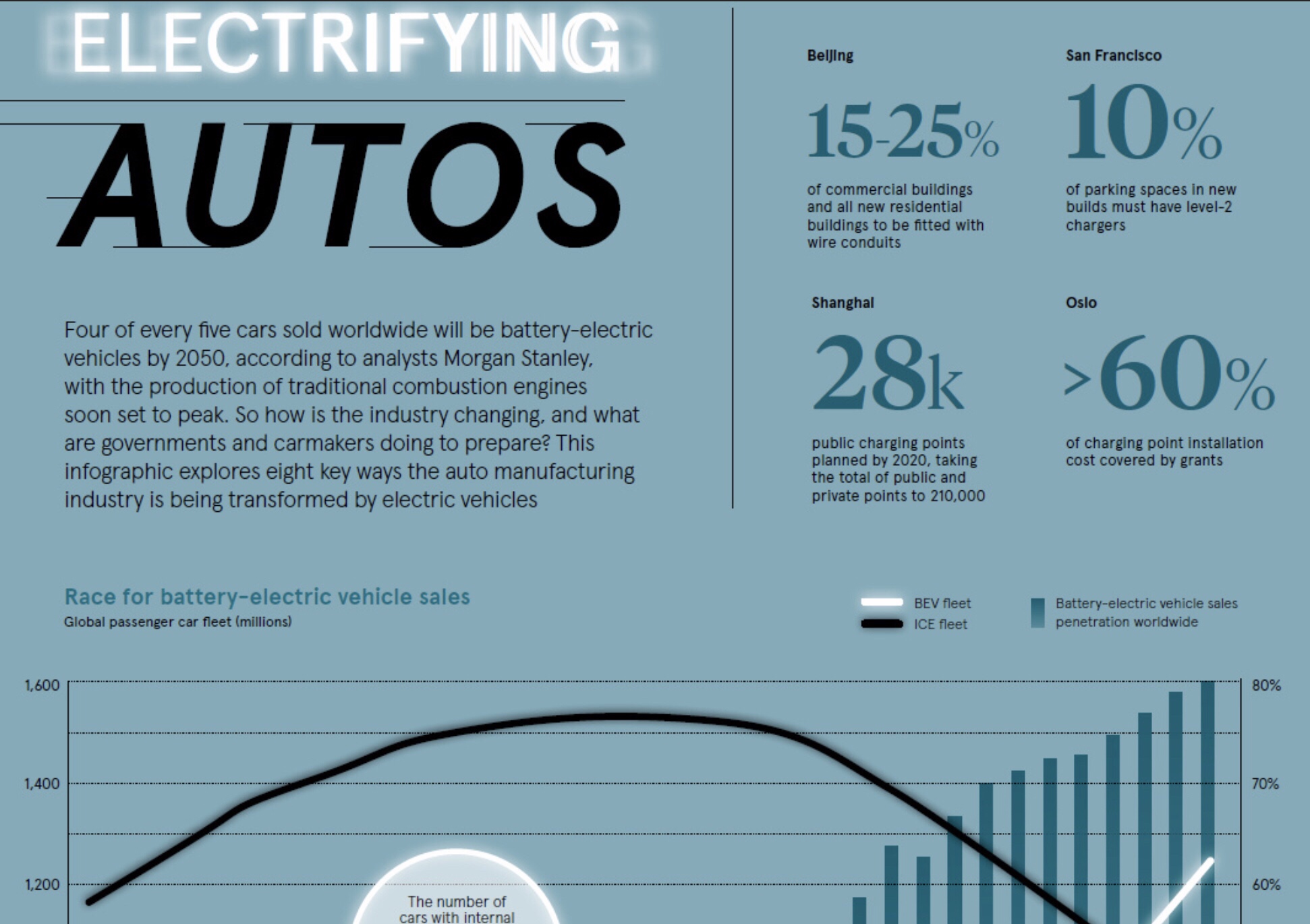
    Of course, there are good reasons for focusing on this field – and once more Visual Capitalist has done a great job capturing some of them in a new infographic.

    The rise of the electric vehicle – and especially its pace – has taken many by surprise. Analysts at Morgan Stanley estimate that four of every five cars sold worldwide by 2050 will be battery-driven EVs.  As the infographic shows, Morgan Stanley analysts further believe that the number of cars with internal combustion engines (ICEs) are to be surpassed by battery-electric vehicles (BEVs) before 2015, as the BEV fleet hits one billion.

    Whatever the adoption timelines ultimately may be, our friends at the American Exploration & Mining Association are spot on with their tweet about what the electrification of vehicles means for the resource realm: “4/5 cars sold in 2050 will be electric.  5/5 will require minerals like cobalt, lithium & iron.”  

    It is time for policy makers to follow up the release of the Department of Interior’s list of 35 metals and minerals deemed critical to U.S. national security with comprehensive policy reforms that help secure domestic supplies of these and many other materials.

    Share
  • Move Over, Lithium and Cobalt, Graphite and Graphene are About to Take Center Stage – Courtesy of the Ongoing Materials Science Revolution

    Earlier this week, we pointed to what we called the “new kid on the block” in battery tech – Vanadium.  It appears that what held true for music, is true in this industry as well – “new kids on the block” arrive in groups. Now, all puns aside – as Molly Lempriere writes for Mining-Technology.com, [...]
  • Vanadium’s Time to Shine?

    Steve LeVine, Future Editor at Axios and Senior Fellow at The Atlantic Council, has called it “one of the most confounding areas of research” and a “technology that, while invented more than two centuries ago, is still frustrating scientists.”   It is also one of the areas where one of the key growth industries – [...]
  • Race to Control Battery Tech Underscores Need for Comprehensive Resource Policy 

    Against the backdrop of the ongoing electric vehicle revolution, automakers are increasingly forced to deal with the realities of resource supply.  One of these realities was spelled out in clear terms by a Wall Street Journal report which stated: “There’s a Global Race to Control Batteries – and China is Winning.  Chinese companies dominate the [...]
  • Lithium – Challenges and Opportunities Underscore Need for Domestic Resource Policy Overhaul

    In an interview with InvestingNews.com, Simon Moores, Benchmark Mineral Intelligence’s managing director and a member of the ARPN panel of experts, discusses challenges relating to Lithium – one of the key materials underpinning EV battery technology. Moores says that big challenges still lie in bringing new supply to the market, but the situation is not [...]
  • Cobalt’s Star Rising Even Further in Light of Breakthrough New Applications?

    Cobalt is a rising star among critical minerals, in large part because of its key role in battery technology.  However, that’s hardly the only reason. The ongoing materials science revolution has produced a new long-term use for Cobalt that may prove to be a technological breakthrough: A California-based company has announced that it has found [...]
  • The U.S. Hunt for Cobalt – a Rising Star Among Critical Minerals – Is On

    “Gold once lured prospectors to the American west – but now it’s cobalt that is sparking a rush,” writes the BBC in a recent feature story about Cobalt, which, as ARPN followers will know, is a “key component in the lithium-ion batteries that power electronic devices and electric cars.”  Once a somewhat obscure metal, Cobalt [...]
  • Chinese Worries over Critical Mineral Supply Should Provide Impetus for U.S. Policy Reforms

    Escalating trade tensions have brought the issue of China’s near-total supply monopoly for Rare Earth Elements back to the front pages of American newspapers. If that isn’t reason enough for policy makers to use the momentum that has been building for the formulation of a comprehensive critical mineral strategy and an overhaul of policies standing [...]
  • Automakers turn to U.S. Market as Potential Source of Lithium

    We’ve said it before, EV battery technology is the new black – and if the metals and minerals fueling this technology are not yet on your radar, you’ve clearly missed the memo.  Even the oil industry is coming to grips with this new reality. As our friends from Benchmark Mineral Intelligence report: “For the first [...]

Archives