
-->
American Resources Policy Network
Promoting the development of American mineral resources.
  • “Critical Minerals Alaska” – Rising Demand and Supply Side Complications Combine as Catalysts to Establish Domestic Sources of Cobalt

    In his latest installment of “Critical Minerals Alaska” – a feature series for North of 60 Mining News that “investigates Alaska’s potential as a domestic source of minerals deemed critical to the United States,” Shane Lasley takes a closer look at Cobalt, one of the key metals underpinning the current EV technology revolution.

    Once an obscure metal you rarely heard about, this co-product of Nickel and Copper has recently been afforded “critical mineral status” – primarily because of its application in Lithium-ion battery technology. Meanwhile, U.S. import reliance for Cobalt is pegged at 72 percent, with recycling providing most of the balance.  This may change soon. Writes Lasley:

    “With at least one advanced stage exploration project in Alaska looking into the potential of producing cobalt alongside its copper, America’s 49th State could provide a domestic source for this critical metal.”

    In light of recent price surges for Cobalt, battery makers, among them Tesla, are looking to develop technologies that require less of the material. However, as Lasley points out:

    “Researchers and analysts do not see a scenario where the reduction of cobalt per battery can come close to offsetting the growing number of batteries that will be needed in the coming three decades.”

    Simon Moores, managing director at Benchmark Mineral Intelligence and member of the ARPN panel of experts agrees, and in a recent tweet challenged Elon Musk to clarify what he meant when tweeting out his assumption that Tesla would reduce cobalt use to zero in their batteries in “next gen.” Moores believes it is “highly unlikely Tesla will be able to eliminate Cobalt from its supply chain entirely” and pegs the probability of such a scenario at one percent.

    With demand on the rise, complex supply chain complications have companies turn to the United States as a potential source of supply.

    As Lasley explains:

    “One of the difficulties is cobalt is seldom mined as a standalone metal. Instead, this increasingly needed battery metal is typically produced as a byproduct at copper and nickel mines. This means that any future cobalt mines would likely need to consider the economics of the moneymaking metal in the deposit.

    “This situation limits producers’ flexibility in adjusting the amount of cobalt mined in response to changes in demand and can result in periods of oversupply or shortage,” according to the USGS.

    While at lower prices, the cost to recover cobalt from copper or nickel mines may not have been economically viable, the demand electric vehicles are putting on this metal has companies taking a closer look at the feasibility of recovering cobalt exploring and developing copper deposits in the United States.”

    Further complicating the situation is Cobalt’s conflict mineral status, which has led to pressures on automakers to source the material outside the Democratic Republic of the Congo (DRC), from which a majority of Cobalt is currently sourced.  This, as Lasley points out, “could add to the catalysts to establish domestic sources of this critical metal.”

    To read the full piece, in which Lasley provides more detail on the feasible Cobalt development projects in Alaska, click here.

    Share
  • Supply Chain Timelines Warrant Comprehensive Policy Approach – A Look at Lithium

    In case you haven’t noticed, EV battery technology is the new black.

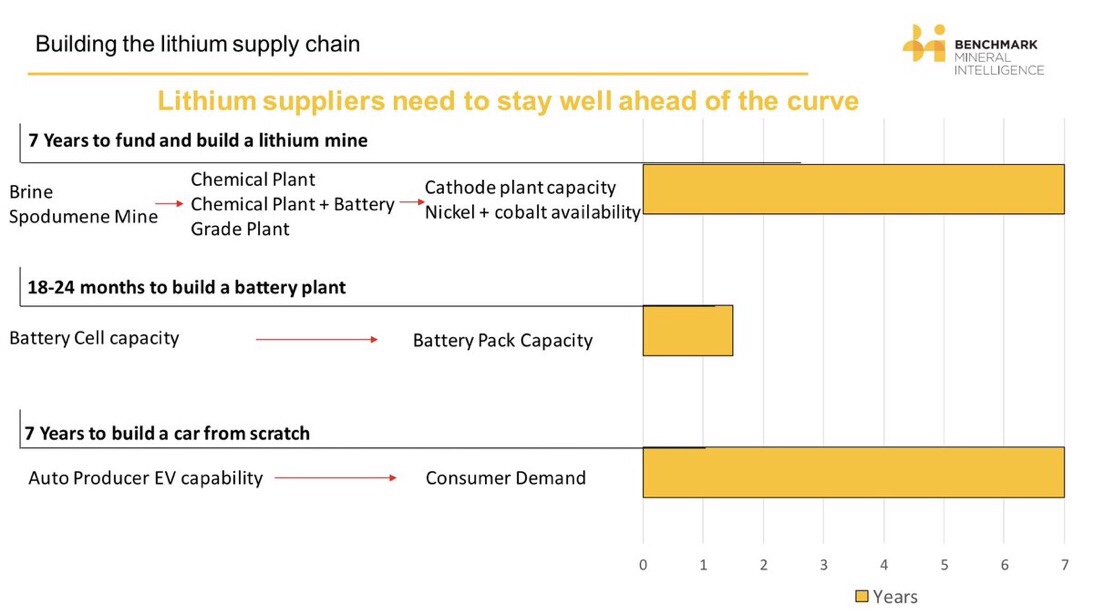
    With Lithium being one of the key metals driving this technology, our friends at Benchmark Mineral Intelligence have looked at the material’s supply chain – and the time it takes to develop the respective components of it.

    As Simon Moores, managing director at Benchmark Mineral Intelligence and member of the ARPN panel of experts, captioned the graphic below in a recent tweet: “The three parts of the lithium ion battery supply chain live in different worlds. Lithium suppliers need to stay well ahead of the demand curve … at the moment they are behind.”

    The chart serves as a great reminder of why resource policy can’t occur in a vacuum – and why it is crucial for policy makers to think strategically and comprehensively.

    Thankfully, the U.S., which has long had the dubious honor of having one of the lengthiest permitting processes for mining projects among the leading mining nations, has embarked on a quest to streamline the policies hampering the responsible development of our nation’s mineral riches. As friends of ARPN know well, U.S. competitiveness and national security are at stake.

    Share
  • Copper Gap Looms as Demand for EV Tech Continues to Surge

    While just a few short years ago, Rare Earth Element coverage dominated non-fuel mineral resource news cycles, it is the metals and minerals that fuel electric vehicle and battery technology that are making headlines these days. Here, the spotlight has been on Cobalt, Lithium, and, to a lesser extent, Nickel and associated supply and demand [...]
  • Materials Science Profiles of Progress: CMI Expands Collaborative Research Focus to Include Lithium and Cobalt

    The Critical Materials Institute (CMI), a Department of Energy research hub under the auspices of Ames Laboratory, is expanding its research on tech metals “as rapid growth in electric vehicles drives demand for lithium, cobalt.” According to a recent Ames Lab press release, the Institute will focus on maximizing the efficiency of processing, usage and [...]
  • Benchmark Mineral Intelligence’s World Tour Returns to U.S. this May

    Our friends from Benchmark Mineral Intelligence – formidable experts when it comes to battery tech and the mineral resources driving it – are returning to the U.S. in May for another round of their World Tour. This year’s tour will “focus on the supply chains for the next generation of battery technologies,” and seek to [...]
  • Sweden Tosses Hat Into Ring In Race For Materials Underpinning EV Revolution

    As the race for the metals and minerals driving the electric vehicle revolution heats up, and China continues to jockey for pole position, Sweden is tossing its hat into the ring.  According to recent media reports, the Swedish government has earmarked 10 million kronor ( roughly one million Euros) to explore the option of digging [...]
  • 2018 – A Tipping Point For U.S. Resource Policy and Related Industries?

    The following is a guest post by ARPN expert panel member Chris Berry, Founder, House Mountain Partners. His expertise focuses on, but is not limited to, energy metals including Lithium, Cobalt, Graphite, Vanadium and Rare Earths. The Executive Order recently signed by President Trump to prioritize domestic natural resource development couldn’t have come at a [...]
  • Lithium – A Material “Coming of Age” is Case in Point for Mineral Resource Policy Reform

    As we have outlined, last month’s executive order on critical minerals could have far-reaching implications for our national security and economic wellbeing.  If you needed a case in point – look no further than Lithium. One of the hottest commodities of the day, Lithium, as ARPN expert panel member and managing director of Benchmark Mineral [...]
  • Automakers Pledge to Uphold Ethical and Socially Responsible Standards in Materials Sourcing. Where Will the Metals and Minerals Come From?

    Late last month, international automakers made headlines when pledging “to uphold ethical and socially responsible standards in their purchases of minerals for an expected boom in electric vehicle production.” As Reuters reported, a group of 10 car manufacturers have formed an initiative to “jointly identify and address ethical, environmental, human and labor rights issues in [...]
  • Nickel – The “Metal That Brought You Cheap Flights” Now “Secret Driver of the Battery Revolution”

    Another week, another great infographic by Visual Capitalist – this time on the “Secret Driver of the Battery Revolution” – Nickel. Long an important base metal because of its alloying capabilities, Nickel’s status as a Gateway Metal, yielding access to tech minerals like Cobalt, Palladium, Rhodium and Scandium – all of which are increasingly becoming [...]

Archives