
-->
American Resources Policy Network
Promoting the development of American mineral resources.
  • Moores’ Law: The Rise of Lithium Ion Battery Megafactories and What it Means for Critical Mineral Resource Supply

    Earlier this month, Simon Moores, Managing Director of Benchmark Mineral Intelligence and member of the ARPN panel of experts testified before the full U.S. Senate Energy Committee on opportunities and risks in the energy storage supply chain.  

    We’re titling his observations as Moores’ Law — which is his for the taking, given the placement of the apostrophe. If he hasn’t used it yet, he should.
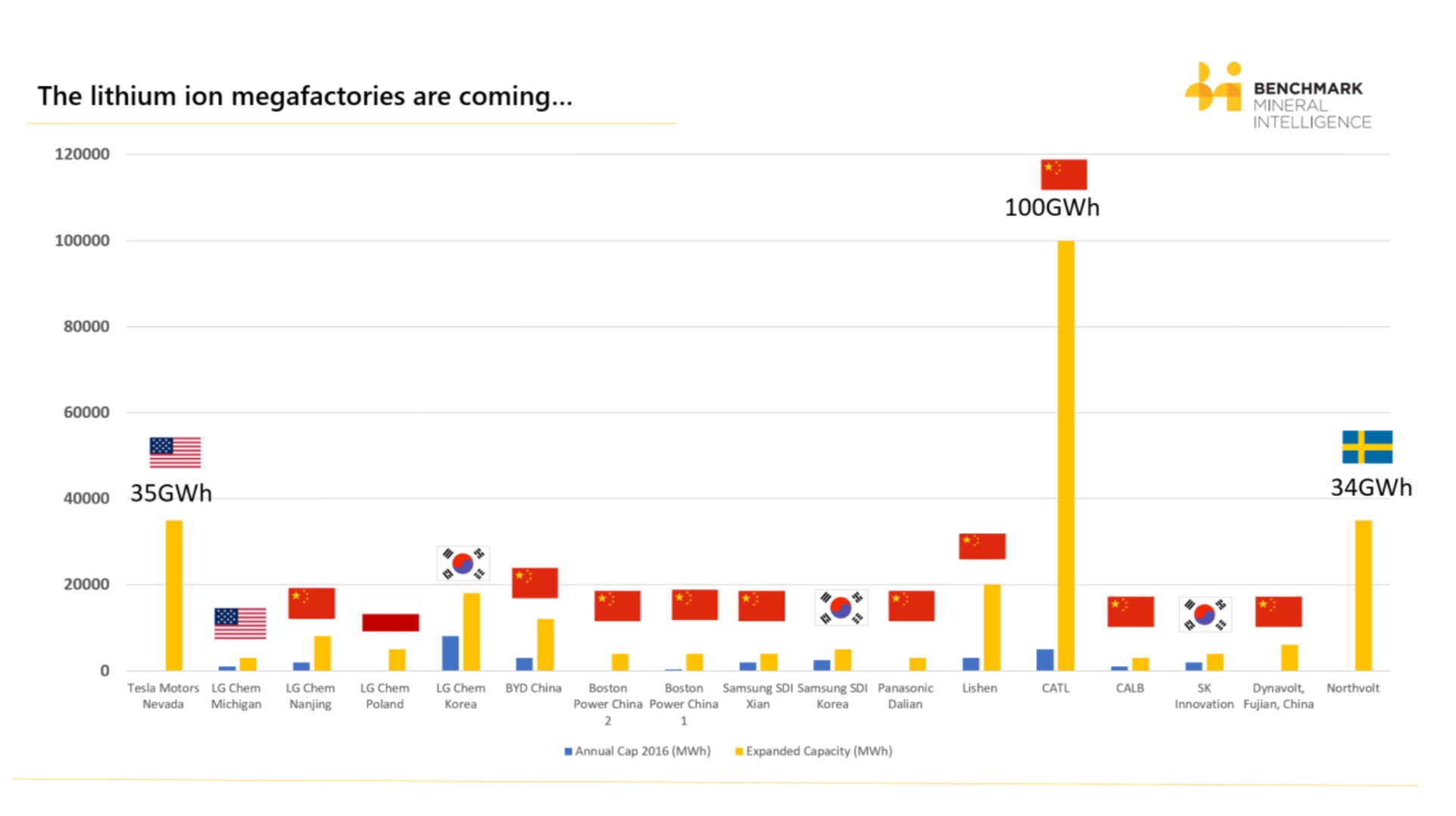
     While we already featured Moores’ top line points regarding the rise of Lithium Ion megafactories (also see the chart), we would be remiss if we didn’t share some of his takeaways on the implications for the main critical raw material inputs for this technology – namely Lithium, Graphite, Cobalt, and Nickel — and add some additional thoughts. 

    Lithium

    • For Lithium carbonate and Lithium hydroxide, the “base chemicals that the battery industry seeks,” Benchmark Mineral Intelligence sees a 10-fold increase in the industry’s demand profile over a ten-year timeframe. Lithium is largely sourced from Chile, Argentina and Australia, and is processed into battery grade in the U.S. and China. 

    • Meanwhile, in a recent op-ed for the Reno Gazette Journal, professor emeritus of mining engineering at the University of Nevada, Jaak Daemen, citing an even higher demand profile increase for Lithium, argued that with only one Lithium mine in the U.S., the United States is unprepared to meet demand with the main problem not being the lack of resources, but “a regulatory approach that endlessly delays bringing mines in production.” 

    Graphite

    • Lithium Ion technology uses both naturally mined flake Graphite as well as synthetic Graphite, in which the former accounts for roughly 60% of inputs, and the latter for roughly 40%. According to Moores’s testimony, China dominates natural flake mining at 62% of global production in 2016, followed by Brazil at 23%.  A similar scenario unfolds for refining, most of which also takes place in China. 

    • According to Moores, “[w]hile large flake graphite mines are being developed outside of China in Mozambique, Canada and the US, processing capacity to make anode material is still lagging.”

    • As we previously highlighted, the U.S. currently produces zero Graphite, with the last American Graphite mine having closed 25 years ago. 

    • As Moores points out, however, two Graphite companies are currently seeking to mine and process flake graphite for battery grade material in the U.S., so there is hope the supply picture will change domestically.

    Cobalt

    • According to Moores, 64% of the Cobalt consumed globally in 2016 was mined in the Democratic Republic of the Congo (DRC), with China dominating the “refining step in the supply chain with 57% of global capacity.”

    • With Cobalt also being a Co-Product to Gateway Minerals like Copper and Nickel, Moores argues that “the fortunes of Cobalt – now driven by battery demand – is still at the mercy of Nickel and Copper commodities which is drive by industrial demand. This is causing long term planning issues for the EV supply chain.”

    • You can read ARPN’s latest blog item on Cobalt here

    Nickel

    • With advances in battery technology and changing formulas, Moores sees battery grade Nickel demand grow “from 75,000 tpa in 2016 to anywhere between 300-400,000 tpa by 2025.” 

    • Nickel production is in the million of tons a year, and from a U.S. point of view, the supply picture recently changed with our import dependence dropping from roughly 50 percent to currently 25 percent with new domestic projects having come online.  

    • However, as Moores points out, “the battery grade chemical material is specialist with only a handful of major producers outside of China.”

    Ultimately, this is food for thought for any discussion regarding the comprehensive mineral resource strategy our nation sorely needs.

    Says Moores:

    “Where we stand today in 2017, China is not only a the center of mass market EV development and deployment but also of cathode production, battery grade raw material refining and the building of the new battery cell capacity.  Those that control raw material and chemical / cathode refining know how and capacity will control the lithium ion battery supply chain. And those that control the lithium ion battery supply chain will be the biggest influencers on the next generation auto and energy industries.”

    Share
  • ARPN’s McGroarty for Investor’s Business Daily: U.S. Mineral Resource Dependence a “Clear and Present Danger”

    Against the backdrop of growing threats to U.S. security – recent flash points involve Russia, China, Iran, and North Korea – a new Presidential Executive Order “On Assessing and Strengthening the Manufacturing and Defense Industrial Base and Supply Chain Resiliency of the United States,” zeroes in on defense readiness. The E.O. requires heads from various cabinet departments to submit to the President policy recommendations for strengthening the U.S. defense industrial base.

    The problem, as ARPN’s Daniel McGroarty outlines in a new commentary for Investors Business Daily, runs far deeper than scenarios in which “there is only one U.S. company that can repair submarine propellers – (…) Our metals and minerals dependency on foreign sources of supply is great and growing.”

    ARPN followers are familiar with the overall picture: According to the U.S. Geological Survey, we are 100% reliant on foreign imports for 20 metals and minerals. For another 50, we are more than 50% import dependent – with China being a leading supplier for 28 of the 50. 

    McGroarty points to fused aluminum oxide to underscore the severity of the situation, arguing that “there’s nothing quite like a raw material shortage to bring the lengthiest supply chain to a standstill:” 

    While we are more than 75% import dependent for our annual domestic fused aluminum oxide supply, according to USGS, defense-grade aluminum fused oxide is even harder to come by, leaving our import dependency for this material at 100%, with the world’ leading providers being China and Venezuela – none of which are the poster children of reliable trading partners. 

    Says McGroarty:

    “In announcing the Executive Order, Navarro noted that it ‘does not silo defense, the economy and trade and the workforce,’ but embraces ‘all the interconnections between a strong manufacturing base, a strong industrial base, a strong workforce … that strengthen our tax base which … allows us to buy the material and weapons.’

    A fine and expansive statement, to which we should make a one-word amendment: Instead of buying the strategic materials used in U.S. weapons platforms, whenever we can, we should be mining that material here at home.

    And that requires reversing the slide that has seen the U.S.’s share of global mining exploration investment in steady decline the past two decades, even as the length of the federal permitting process has doubled. Here, we need not wait for the President’s Defense Industrial Base report; we should press for passage of critical minerals legislation now before the Congress, with meaningful permitting reform.”

    McGroarty has additional suggestions as to what can be done to foster a policy environment conducive to harnessing our nation’s arguably vast mineral potential, and calls for the realization of the strategic importance of mainstay metals like Copper, which in the tech metal era, serve as “Gateway metals” to other critical minerals. 

    He concludes:

     “Defense readiness has long been a key bulwark of American strength — and worrying about it has an equally lengthy pedigree. In his oft-quoted farewell address, in a largely overlooked passage, President Dwight Eisenhower warned: ‘We can no longer risk emergency improvisation of national defense.’ That was 1961, at the height of the U.S.-Soviet Cold War.

    In 2017, with threats emanating from Moscow, Beijing, Pyongyang and Tehran, this is one instance where it would pay for America to Be Like Ike.” 

    The time for a strategic overhaul of our mineral resource policy is now. 

    Share
  • Why Cobalt Should be High on Your Radar

    In a recent article, the Financial Times zeroes in on one of the metals followers of ARPN will know is becoming increasingly indispensable to 21st Century clean energy technology: Cobalt.  Once an obscure metal you rarely heard about, this co-product of Nickel and Copper is increasingly afforded “critical mineral status” – primarily because of its [...]
  • Rare Metal Find Brings Seabed Mining Back into Focus

    Japanese researchers have discovered a vast deposit of “rare and important” metals on the seabed off the Boso Peninsula in Chiba Prefecture, Japan. According to the Asahi Shimbun, “the cobalt-rich crust forms around rocks on the seabed” in an area of about 950 square kilometers to the East of Tokyo. The deposit is said to [...]
  • Africa Taking Center Stage in China’s Quest for Resources

    It is “the single largest source of mineral commodities for the United States, particularly for resources like rare earth elements, germanium, and industrial diamonds,” according to the United States Geological Survey, which notes in its most recent Mineral Commodity Summaries report that “of the 47 mineral commodities that the United States is more than 50 [...]
  • Happy Independence Day! We’re Free, Yet So Dependent

    Happy Birthday, America! Another trip around the sun, and we’re back on the eve of the 4th of July gearing up for parades, barbecues and fireworks in honor of the men and women who have fought, and continue to safeguard our freedom today. Last year, we used this opportunity to point out that while we cherish [...]
  • Scandium – Ready to “Take Off”?

    Remember the Light Rider?  A few months ago, we highlighted this high-tech motorcycle, which, because it is held together by an intricate web of “Scalmalloy,” is perhaps the lightest motorcycle in the world. Scalmalloy is an “aluminum alloy powder ‘with almost the specific strength of titanium’ [used] to build incredible structures by fusing thin layers of the material together.” One [...]
  • Advances in Materials Science Warrant Rethink in Resource Policy

    We appreciate them for their traditional applications, but metals like Copper and Tin are far more than your mainstay materials.  We discussed their Gateway Metal status here, but it’s not just the fact that their development yields access to some of the most sought-after tech metals that makes them so indispensible – it’s advances in materials [...]
  • Rhenium: “Alien Technology” Underscores Importance of Gateway Metals and Co-Products

    At ARPN, we have consistently highlighted the importance of Gateway Metals, which are materials that are not only critical to manufacturing and national security in their own right, but also “unlock” tech metals increasingly important to innovation and technological development. With advancements in materials science, these co-products, many of which have unique properties lending themselves [...]
  • EPA Settlement on Pebble Deposit Positive Development for Due Process Advocates

    A few years ago, the U.S. Environmental Protection Agency (EPA) made a splash when it took unprecedented early action in an effort to derail the development of one of the largest domestic deposits of key strategic mineral resources (Copper, Molybdenum, Gold, Silver and Rhenium) – the so-called Pebble Deposit in Southwestern Alaska.  In spite of the fact [...]

Archives