-->
American Resources Policy Network
Promoting the development of American mineral resources.
  • As Clean Energy Adoption Reaches “Tipping Point,” the Challenge of Untangling Critical Mineral Supply Chains Looms Larger than Ever

    “Solar power, electric cars, grid-scale batteries, heat pumps—the world is crossing into a mass-adoption moment for green technologies,” writes Tom Randall for Bloomberg.  Citing Bloomberg research, he argues that “clean energy has a tipping point, and 87 countries have reached it.” 

    The mass-adoption of green technologies, as followers of ARPN well know, requires drastically increased amounts of critical minerals, including the Rare Earths and mainstays such as copper, as well as, perhaps most notably, the so-called “battery criticals” lithium, cobalt, graphite, nickel and manganese — key  inputs for EV battery technology, which is at the heart of the green energy transition.

    Randall writes that the U.S. has passed a “critical EV tipping point: 5% of new car sales powered only by batteries,”and argues that “[i]f the U.S follows the trend established by 18 countries that preceded it, a quarter of new car sales could be electric by the end of 2025.”

    These emerging trend lines, along with the realization that supply chains for many metals and minerals leave us at the mercy of adversary nations like China who control much of the material supplies and processing capabilities, have prompted the Biden Administration and members of Congress to finally give the critical mineral supply chain conundrum ARPN and others have long warned of the attention it deserves.

    Thus, in recent years, stakeholders began taking steps to strengthen domestic supply chains for critical minerals, with the supply chain chaos resulting from coronavirus pandemic and rising geopolitical tensions kicking these efforts into high gear in 2022.

    Much of these efforts have focused on the rare earths and battery criticals, such as the March 2022 Presidential Determination to invoke the Defense Production Act for these materials, which grants the  federal government the authority to direct taxpayer funds to private companies for the extraction of said minerals.

    However, untangling the supply chains is proving more difficult than some would have thought — and new sourcing requirements for the battery criticals contained in the energy provisions of the the recently passed Inflation Reduction Act may have added another layer of complications to an already challenging situation.

    Earlier this summer, a RealClearInvestigations exposé discussed the alleged China connections of a domestic lithium extraction project in Nevada, where, as RealClear’s Steve Miller writes “a Chinese-dominated mining company has procured millions of dollars in American subsidies to extract lithium in the United States – but, given a dearth of U.S. processing capacity, the mineral is likely to be sent to China with no guarantee that the end product would return as batteries to power President Biden’s envisioned green economy.”   U.S. Senator Tom Cotton recently called for additional information from the Department of Energy regarding the alleged China connection of the project, which we  discussed here.

    The Nevada project is is still in the permitting process, but similar scenarios have already unfolded elsewhere, such as in the case of rare earths magnets used in engine parts for F-35 fighter jets, where the U.S. Department of Defense has resorted to granting a waiver for sourcing requirements because at the current time acquisition of parts without Chinese components is not possible.  While the U.S.’s national security imperatives may make a rare earth waiver unavoidable, it should serve to turbo-charge domestic rare earth supply chain development to break the U.S. Armed Services’ Chinese rare earth dependency once and for all.

    In the same vein, as Miller writes discussing the above-referenced project in Nevada, “critics say the scenario would increase U.S. energy dependence on a hostile power – one accused of using forced labor in the manufacture of both lithium batteries and solar panels – and undercuts the Biden administration’s emphasis on domestic sourcing of green energy,” experts have long warned that decoupling supply chains for lithium, for example represents a formidable challenge.

    As Simon Moores, chief executive of Benchmark Mineral Intelligence argued in the wake of the passage of the Inflation Reduction Act, “[c]onsidering it takes seven years to build a mine and refining plant but only 24 months to build a battery plant, the best part of this decade is needed to establish an entirely new industry in the United States.”

    Both assertions are accurate — yet, as we previously outlined:

    “Senator Cotton’s point [regarding the Nevada project] that questions of foreign control deserve to be fully investigated before the U.S. Government confers funding seems unarguable. Government programs intended to alleviate worrisome foreign resource dependencies should not unwittingly strengthen those dependencies at the expense of the American taxpayer – and American national security.”

    As clean energy adoption reaches a “tipping point,” this is all the more reason for stakeholders to place an even stronger emphasis on formulating and implementing a comprehensive “all-of-the-above” strategy for domestic critical mineral resource supply chain security — today.

    Share
  • U.S. Department of Energy Announces Federal Grants to “Supercharge” U.S. EV Battery and Electric Grid Supply Chains

    The global push towards net zero carbon marches on, and with sales of EVs continuing to soar even as prices rise, analysts suggest that the world could be nearing a critical electric vehicle sales tipping point, when volatile adoption trends are overtaken by mainstream demand.” 

    With skyrocketing demand, the mineral intensity of the green energy transition and supply chain challenges associated with our over-reliance on adversary nations, most notably China, has finally resonated with stakeholders. The passage of the Bipartisan Infrastructure Law in the summer of 2021 represented an important step towards decoupling U.S. critical mineral supply chains from adversary nations.  Others have since followed.

    Today marks another key step: As part of the implementation of the 2021 infrastructure law, the U.S. Department of Energy announced the first round of funding under the Act for projects aimed at “supercharging”  U.S. manufacturing of batteries for electric vehicles and electric grid.

    Awardees — a total of 20 companies — will receive a combined $2.8 billion “to build and expand commercial scale facilities in 12 states to extract and process lithium, graphite and other battery materials, manufacture components, and demonstrate new approaches, including manufacturing components from recycled materials.”

    According to the Department of Energy announcement, recipients will match the federal funds to leverage a total of more than $9 billion “to boost American production of clean energy technology, create good-paying jobs, and support President Biden’s national goals for electric vehicles to make up half of all new vehicle sales by 2030 and to transition to a net-zero emissions economy by 2050.”

    The supported projects span the entire value chain, with funding going towards:

    • Developing enough battery-grade lithium to supply approximately 2 million EVs annually
    • Developing enough battery-grade graphite to supply approximately 1.2 million EVs annually
    • Producing enough battery-grade nickel to supply approximately 400,000 EVs annually
    • Installing the first large-scale, commercial lithium electrolyte salt (LiPF6) production facility in the United States
    • Developing an electrode binder facility capable of supplying 45% of the anticipated domestic demand for binders for EV batteries in 2030
    • Creating the first commercial scale domestic silicon oxide production facilities to supply anode materials for an estimated 600,000 EV batteries annually
    • Installing the first lithium iron phosphate cathode facility in the United States

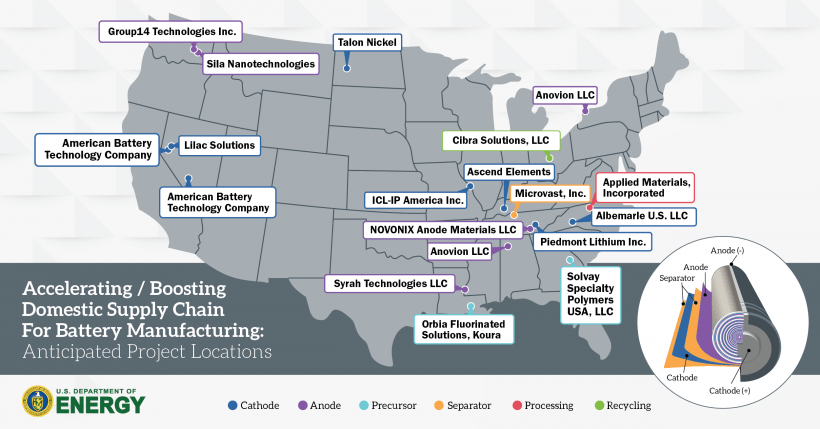
    The map provides a snapshot of anticipated project locations:

    C0C7A866-95AD-4AB3-86D0-781F86BA2EF4

    More details and individual project information can be accessed here.

    According to DoE, the department “anticipates moving quickly on additional funding opportunities to continue to fill gaps in and strengthen the domestic battery supply chain,” and ARPN will continue to keep tabs on these efforts.


    Share
  • DoL “List of Goods Produced By Child Labor or Forced Labor” Zeroes in on Lithium-Ion Batteries, Adding Pressures for Already Strained Material Supply Chains

    Pressures on already strained battery material supply chains are mounting, and not just due to geopolitical tensions and rising demand in the context of the green energy transition. The U.S. Department of Labor has included lithium-ion batteries into its “List of Goods Produced by Child Labor or Forced Labor” – a list of 158 goods from 77 [...]
  • Pentagon Waiver for REE Magnets Used in F-35 Combat Jet Engines Underscores Critical Mineral Dependency Conundrum

    With the coronavirus pandemic and growing geopolitical tensions having shone a light on U.S. over-reliance on foreign sources across our nation’s critical mineral value chains and its implications for our national and economic security, domestic stakeholders have stepped up their efforts to decouple U.S. supply chains from reliance on our adversaries. While for “battery criticals” [...]
  • State-Level Public-Private Cooperation to Bolster Critical Mineral Supply Chains: A Look at Michigan

    At ARPN, we have long been spotlighting federal policy initiatives to bolster our critical mineral supply chains. Meanwhile, often considered policy laboratories, the individual states are also not sitting idly by, and it’s time to feature some of their efforts. With the EV revolution fueling much of the skyrocketing demand for the “battery criticals” lithium, cobalt, graphite, nickel [...]
  • National Clean Energy Week Underscores Importance of Critical Mineral Supply Chains

    Underscoring the importance of the green energy transition to modern society, the U.S. Senate earlier this week passed a resolution, the U.S. House of Representatives  introduced a corresponding resolution, and several governors issued their own declarations designating September 26th through 30th “National Clean Energy Week.” National Clean Energy Week is billed as an annual week-long “celebration of clean energy innovation” to “help solve [...]
  • Not Just the “Battery Criticals” — Green Energy Transition’s Mineral Intensity Requires Broader Focus: A Look at the “Solar Metals”

    Recent media coverage might have you believe critical mineral policy only revolves around the “battery criticals”lithium, graphite, nickel, cobalt and manganese, and maybe the frequently referenced, though still somewhat obscure rare earths.  However, as followers of ARPN well know, this is far from the truth. The New South Wales Department of Planning and environment has taken a [...]
  • European Union to Step Up its Critical Minerals Game against the Backdrop of Surging Demand Forecasts

    The Russian invasion of Ukraine and subsequent additional supply chain challenges have prompted the European Union — already grappling with strained supply chains in the wake of the coronavirus pandemic — to step up its critical minerals game. During her State of the Union address on September 14, European Commission President Ursula Von der Leyen announced [...]
  • As Automakers Scramble to Build Out EV Manufacturing, Calls for Mine Permitting Reform Get Louder

    Against the backdrop of ongoing supply chain challenges around the globe, the urgency of untangling and securing critical mineral supply chains essential to a net zero carbon emissions future is becoming increasingly clear. Following on the heels of the Biden Administration invoking the Defense Production Act for the “Battery Criticals” – lithium, cobalt, graphite, nickel and manganese [...]
  • Alaska Critical Minerals Conference: Stakeholders Welcome Progress Thus Far, Call for Federal Permitting Reform and More Predictability in the Mining Space

    Just as a new federal law – the Inflation Reduction Act of 2022 – may send a much-needed investment signal to the underdeveloped critical mineral supply chains for EVs and other 21st  century technologies, many of which are rife with underinvestment, political risk and poor governance – lawmakers and policy experts gathered for a two-day two-day conference hosted by the [...]

Archives