
-->
American Resources Policy Network
Promoting the development of American mineral resources.
  • Wilson Center Embraces All-of-the-Above Multidimensional Strategy for Supply Chain Security, Calling for “Mosaic Approach” in New Study

    In early October, the Woodrow Wilson International Center for Scholars announced the release of a new report entitled “The Mosaic Approach: a Multidimensional Strategy for Strengthening America’s Critical Minerals Supply Chain.” 

    According to Duncan Wood, Vice President of Strategy and New Initiatives at the Wilson Center and one of the report’s co-authors, “[the] paper reflects the dialogue sustained by a high-level group of stakeholders in the summer of 2021 and argues that the United States must take a number of key steps to make the critical minerals supply chain more resilient. (…) These minerals are vital for the energy transition and for the United States’ geopolitical ambitions.”

    The report’s authors call for a “Mosaic Approach,” to our nation’s critical mineral resource woes — involving action by both the private sector and the government at the national and international levels.

    If the overall thrust of the report sounds familiar to followers of ARPN, that is is because it is.  ARPN has long called for the U.S. to embrace a variant of the “all-of-the-above” strategy we’ve come to know from energy policy discourse.

    This — in the context of strengthening U.S. supply chains — would mean a focus on new mining, recycling and reclamation of new minerals from old mine tailings both domestically and within the context of our relationships with our closest allies, as well as building out and leveraging domestic and allied processing capabilities — like filling in the pieces of a mosaic.

    While much of the current discourse on strengthening critical mineral supply chains takes place in the context of the accelerating green energy transition focusing on Cobalt, Lithium and the Rare Earths, the Wilson Center report highlights the importance of the more traditional mainstay metals of Copper and Nickel:

    “Nickel and copper are two other metals integral to the global energy transition and national security. Copper production is dominated by Chile followed by Peru, China, the United States, and the DRC. Copper and copper alloys are utilized in building and infrastructure projects. Additionally, copper’s conductivity makes it a key mineral for electrical and electronic products. Copper is essential for anode current collection, cell wiring, and for EV charging infrastructure. Due to the importance of electrification to meet global environmental sustainability goals, copper is a strategic and important resource.

    Nearly 80% of global nickel is used to produce super alloys and strong materials, such as stainless steel. The amount of nickel used for battery manufacturing is quickly increasing. The largest nickel producing countries in the world are Indonesia, the Philippines, Russia, New Caledonia, a French territory in the South Pacific, and Canada. The U.S. is home to only one nickel-producing mine, located in Michigan. Nearly all of U.S. produced nickel is exported abroad for further processing and refinement. Polymetallic nodules on the ocean floor represent a significant domestic opportunity for increasing U.S. supplies of nickel, with the added bonus that they also contain cobalt and manganese.”

    The charts featured in the Wilson Center report’s chapter on “identifying the weaknesses in the CMSC” calling out three key vulnerabilities (challenges of rising demand, global competition with China and governance challenges), underscore that “the United States does not hold an advantage in geographic concentration of critical minerals” – a timely reminder that developing domestic resources must be augmented by cooperation with our allies.
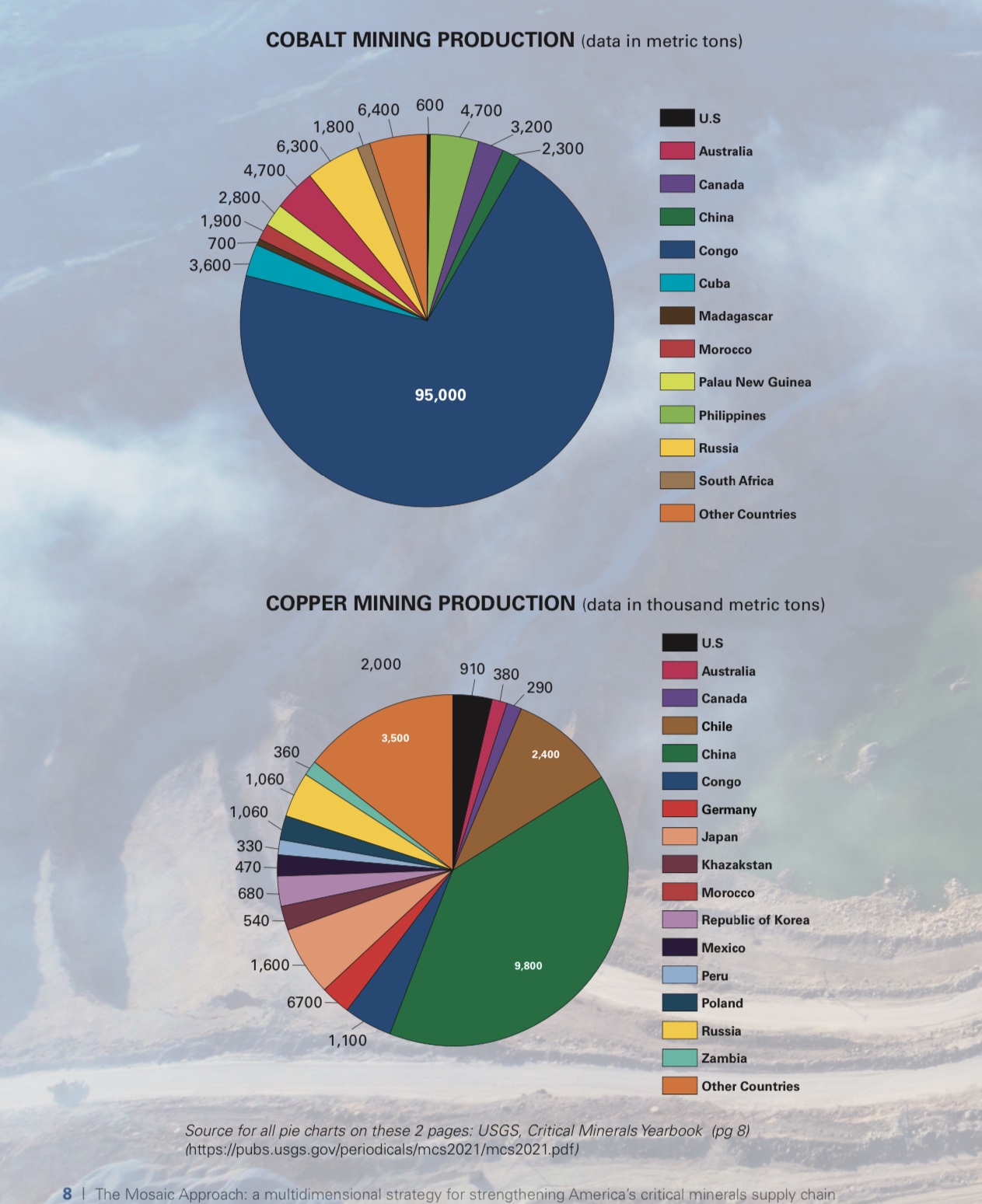
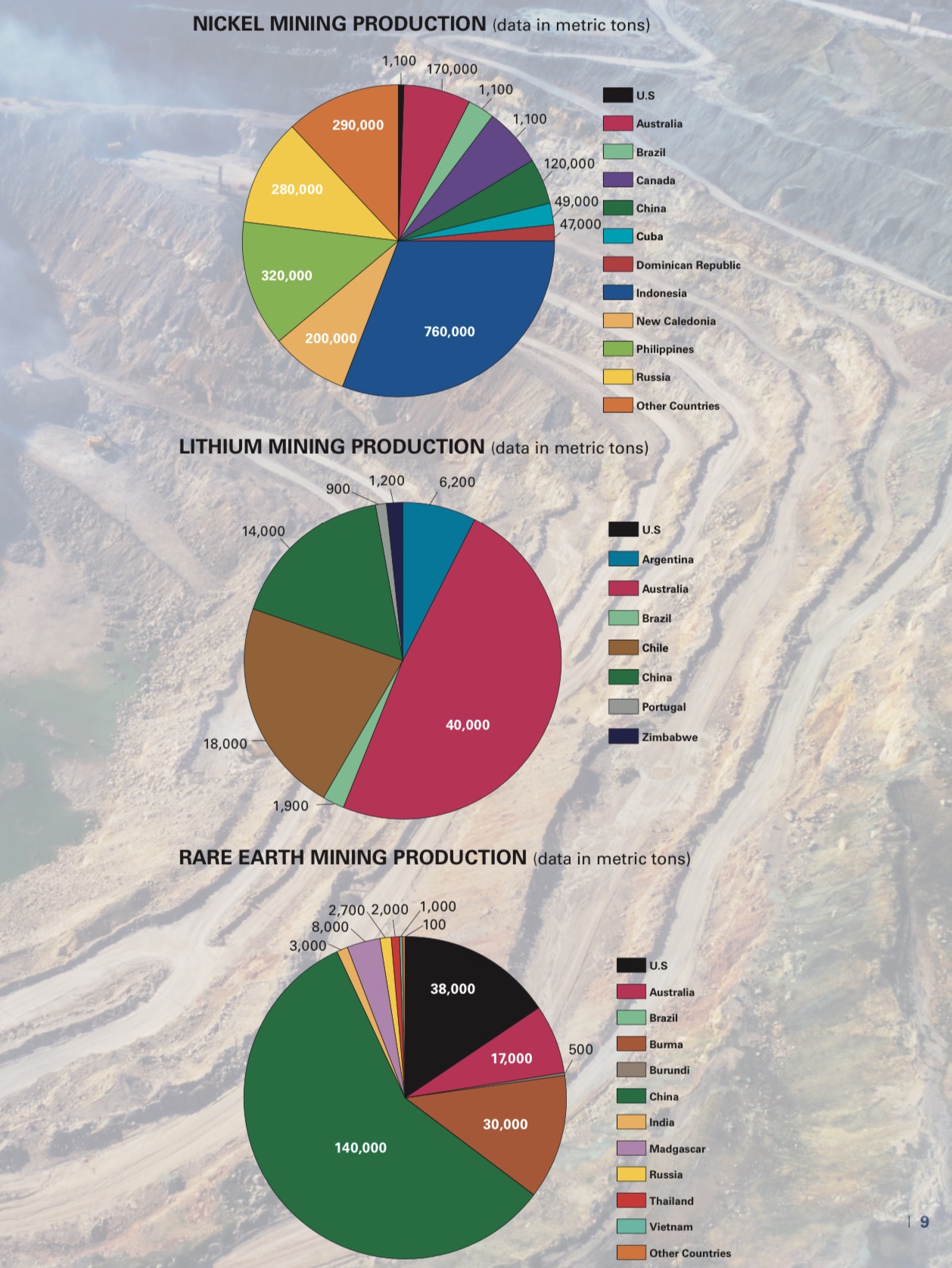
    ABB97869-0AFF-4EE0-BD90-E923CC437B30
    B01271DE-ED2F-4555-BF09-73A04B3FD856

    The authors conclude:

    “Central to all of these endeavors will be the ongoing cooperation between the U.S. government and the private sector. Stakeholder dialogue is an absolute necessity if the attempts to make America’s critical minerals supply chains more resilient are to be effective. Working with the market rather than against it, harnessing the potential of American enterprise and innovation, and joining with our allies around the world will provide the U.S. with the tools it needs to address the China challenge and to meet its climate ambitions.”

    To strengthen domestic manufacturing and national security, we must build out secure and reliable supply chains for all materials underpinning 21st Century technology – both the tech metals and mainstay metals — and address vulnerabilities all along the value chain, from mining to processing and manufacturing.  The Wilson Center report is the latest to call on Congress and the Administration to put in place a comprehensive supply chain policy, anchored in the critical minerals and metals that provide form and function to our modern technology.

    Share
  • Strengthening U.S.-Canadian Critical Mineral Resource Cooperation in the Context of an All-of-the-Above Strategy

    Against the backdrop of a new government having been elected in Canada, former U.S. ambassador to Canada David Jacobson makes the case for the United States and Canada to deepen cooperation in the realm of critical mineral resources in a recent piece for the Globe and Mail.

    Highlighting the longstanding “long and productive partnership on everything from defence to the economy, and today (…) making headway in crafting a continental approach to fighting climate change and improving labour standards,”Jacobson argues that “the strong relationship between the two countries is even more important as we face a potential crisis on the horizon (…)  — North America’s lack of the supply chain necessary for the extraction and refining of ‘critical minerals.’”

    Former ambassadors are understandably diplomatic, but followers of ARPN will understand that we don’t see this crisis as “on the horizon” – but as a clear and present danger, to borrow a famous phrase.

    Ambassador Jacobson draws parallels to the 1970s oil embargo, which resulted in global market disruptions, and says that “if a minerals crisis occurred to similar effect as the oil crisis, every technology, job, business or sector that depends on a battery, a computer chip, or high-tech alloys would be at risk.”

    His bottom line:

    “The good news is a solution exists, right beneath our feet. There are deposits of cobalt, nickel, lithium, graphite and many other critical minerals across North America, including in California, Nevada, Minnesota, Northern Ontario and Quebec. But we have not exercised the resolve to extract them or to develop the supply chain necessary to refine them here rather than ship raw materials overseas only to ship finished products back again.

    It’s not just about securing the supply. Canada and the U.S. stand to see a huge benefit from these increasingly valuable resources while keeping the economic growth and job opportunities at home not just in mining and refining but, more importantly, in making all the products that rely on these critical minerals.”

    It’s time to harness the special relationship between the two countries – which indeed is “more than metaphorical” as ARPN’s Daniel McGroarty phrased it in a 2018 piece for Investors Business Daily— as well as frameworks for allied cooperations such as the National Technology Industrial Base (NTIB), which, originally established to strengthen technology links between the U.S. and Canada in 1993, was expanded in 2016 to include the United Kingdom and Australia.

    Jacobson is right when he says: “We are in a race against time, and we cannot always count on the competition to play fair. Americans and Canadians have historically pulled together for the good of both nations in times of challenge. Such times are coming. Let’s once again plan for, face and beat this new challenge by together establishing our place in the global supply chain.”

    Let’s do it. Let’s build out an integrated North American supply chain for critical minerals where possible — but let’s also not forget that closer cooperation with our friends and allies AND strengthening domestic resource development should not be considered mutually exclusive strategies.

    Share
  • A Hot Take From Detroit: Time to Bring Battery Production Here — All the Way to The Mines

    As the electrification of the global vehicle fleet continues to gain steam, Ford Motor Co.’s president and CEO Jim Farley recently made some comments during a live-streamed interview with the director of Detroit Homecoming VIII Mary Kramer that should give policy makers some food for thought. Expressing his concerns about the affordability of electric vehicles [...]
  • Wind Turbine Makers’ Price Challenges Sign of Looming Raw Material Shortfalls

    As lawmakers on Capitol Hill are scrambling to finalize major federal spending legislation set to include several key provisions relating to natural resources, a recent Wall Street Journal piece on wind power underscores the urgency of our nation’s looming raw material shortfalls. Against the backdrop of surging demand in the context of the green energy transition, wind [...]
  • Industry Experts Lament Inclusion of Hardrock Mining Royalties and Fees in Reconciliation Spending Package

    Against the backdrop of the accelerating battery arms race, and a recent growing realization that our nation has become over-reliant on critical mineral imports from adversary nations, the U.S. House of Representatives Natural Resources committee has added language to the proposed $3.5 trillion reconciliation spending package last week that could throw a serious wrench into [...]
  • Closing the Loop “Contributor” to Solving our Critical Mineral Resource Woes, “Not a Solution”

    As the global battery arms race continues to heat up amidst surging demand for EV battery technology and energy storage systems, a recent Financial Times piece explores the themes of urban mining and closed-loop solutions to increase critical mineral resource supply. The piece outlines a significant challenge with regards to today’s critical mineral resource supply [...]
  • To Lead in EV Revolution, We Must Ramp Up U.S. Mineral Production

    “The U.S. has for too long ceded control of the front end of our manufacturing supply chains to foreign nations, assuming the materials we require will be there when we need them,” writes National Mining Association president and CEO Rich Nolan in a recent Boston Herald piece. In doing so, the U.S. has allowed China [...]
  • The Genesis and Development of the “Battery Arms Race”

    It’s no secret in the critical minerals space — and increasingly beyond — that “we are in the midst of a battery arms race.”  Today, “battery arms race” is a frequently used phrase to describe the rise of lithium Ion battery megafactories, but did you know that it was one of the ARPN expert panel members who [...]
  • “Undoubtedly Good News for Industrial Metals” – a Look at the Senate-passed Infrastructure Package

    In a recent piece for Reuters, columnist Andy Home unpacks the U.S. Senate-passed bipartisan infrastructure package.   While the bill has yet to make it through the U.S. House of Representatives and a likely conference committee, it is worth taking a look at what its passage could mean for the critical minerals sector. According to Home, the [...]
  • Make Haste Slowly – The Inherent Risks of an Electrification of the U.S. Military: Material Inputs, Geopolitics and Cyberattacks

    As governments around the globe continue to push towards carbon neutrality, Alan Howard and Brenda Shaffer, faculty members at the U.S. Naval Postgraduate School, warn against the hidden dangers of the — rushed — electrification of the U.S. military in a new piece for Foreign Policy. Against the backdrop of the Pentagon having commissioned studies [...]

Archives