-->
American Resources Policy Network
Promoting the development of American mineral resources.
  • New USGS Methodology Identifies 23 Mineral Commodities at Greatest Risk to Supply Disruption

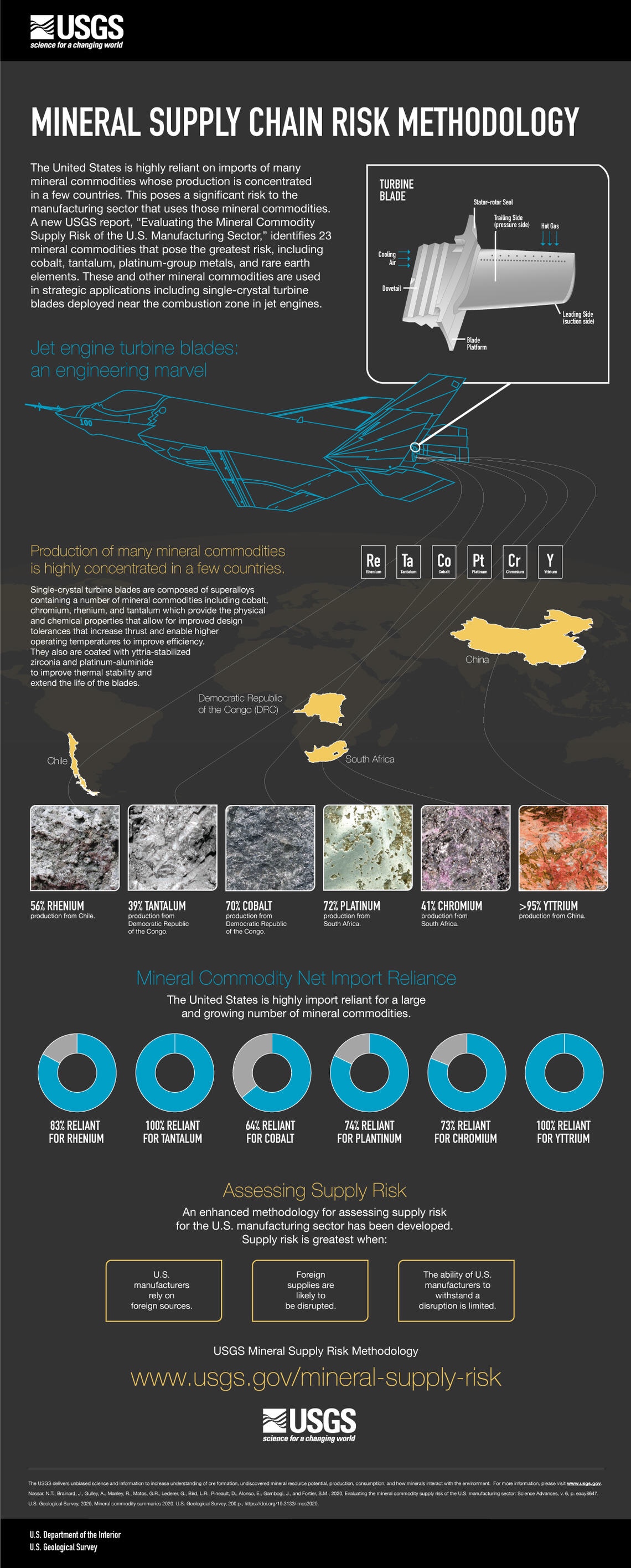
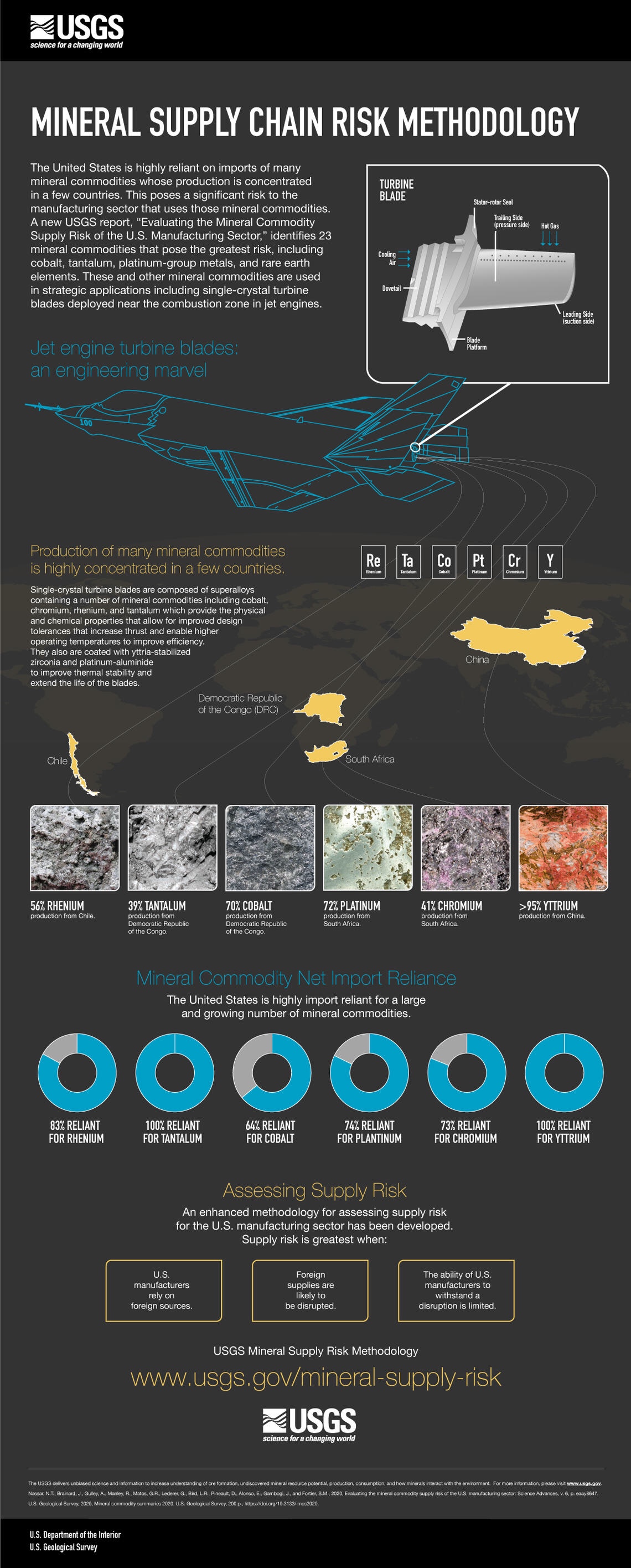
    A new risk tool developed by researchers at the U.S. Geological Survey and its partners identifies 23 metals and minerals relevant to U.S. manufacturing that are at greatest risk to supply disruption.

    The methodology, entitled “Evaluating the Mineral Commodity Supply Risk of the U.S. Manufacturing Sector” and published in Science Advances was developed to help meet the goals outlined in the 2019 interagency report entitled “A Federal Strategy to Ensure a Reliable Supply of Critical Minerals,” which was released  pursuant to President Trump’s Executive Order 13817 of 2018.

    The report evaluated the global supply of and U.S. demand for 52 mineral commodities for the years 2007 to 2016.

    Researchers determined that “[t]he supply risk of mineral commodities to U.S. manufacturers is greatest under the following three circumstances: U.S. manufacturers rely primarily on foreign countries for the commodities, the countries in question might be unable or unwilling to continue to supply U.S. manufacturers with the minerals; and U.S. manufacturers are less able to handle a price shock or from a disruption in supply.”

    The subset of 23 metals and minerals identified in the methodology as posing the greatest supply risk for the U.S. manufacturing sector includes some rare earth elements, cobalt, niobium and tungsten.

    The authors of the report point out that supply risk (SR)  is “dynamic, increasing and decreasing with changing global market conditions that are specific to each commodity and industry” and that “[a] commodity with supply that is not at high risk today may become at high risk in the future as production and consumption patterns shift.”  However, they found that “significant changes in SR over short periods of time are rare,” and while “SR scores can and do change markedly, the subset of commodities with the highest SR has been largely consistent throughout the time period examined.”

    With risk arising at the “confluence of the three factors: hazard, exposure and vulnerability,”supply risk can be achieved by reducing any of these three. The authors point to the 2019 interagency report spearheaded by the U.S. Department of Commerce which effectively called for an “all-of-the-above“ approach of diversifying supply, fostering trade relations with strong allies, developing domestic primary and secondary resources and capabilities, recycling and substitution, as well as stockpiling to reduce exposure to supply disruptions. 

    They conclude that “[t]he degree to which any one of these strategies can be successful at minimizing the risk to an acceptable level depends on the specific commodity and the industries involved, as well as what is deemed to be an acceptable level of risk.”

    Here’s USGS’s full-size infographic to accompany the report:

    Share
  • A Mineral Resource Policy for 2020 – New Year’s Resolutions for Resource Policy Stakeholders

    We realize that New Year’s resolutions are somewhat controversial.  Some say, they‘re not worth the paper they’re written on – but we feel that whether or not we implement all of them, they offer a good opportunity to both step back to reflect and set goals as we look at the big picture ahead. And that certainly can’t hurt. 

    With several positive stage-setting steps taken in 2018, 2019 continued to bring a number of positive developments in the realm of mineral resource policy.  

    However, while we appear to be headed in the right direction — towards an all-of-the-above approach in mineral resource policy as outlined in our 2019 recap — most of the resolutions we spelled out last January remain stubbornly valid 365 days later (though not without some tweaks or additions). 

    Without further ado, here’s our updated list of suggested new year’s resolutions for resource policy stakeholders:

    Continue the National Policy Conversation 

    Against the backdrop of the specter of China playing the “rare earths card” setting off alarm bells and the intensifying the battery arms race, the Commerce Department released the long-awaited interagency Commerce Department report pursuant to Executive Order 13817, A Federal Strategy to Ensure Secure and Reliable Supplies of Critical Minerals released in June 2019 at a critical juncture.

    There are indications that it may have served as a catalyst for policy makers across the political aisle to understand the urgency of securing mineral resource supply chains, and the need at long last for a more comprehensive approach to mineral resource policy. In an increasingly toxic political climate in Washington, D.C., it is important that policy makers work to ensure that partisanship does not impede the advancement of policy solutions because, as ARPN‘s Dan McGroarty noted during a recent panel discussion:

    “We can’t admire the problem anymore. We don’t have the luxury of time.“

    This past summer, just as it did in 2010, the Rare Earths issue has once again re-introduced non-fuel mineral resource issues into the mainstream political discourse.  This growing awareness of our nation‘s mineral resource woes should be harnessed — and stakeholders should work to change the sentiment that “neither [political] parties’ base sees critical minerals as such a dire threat.”

    Read!

    The above referenced Commerce report – coupled with studies released in 2018 (DoI‘s Critical Minerals List and DoD‘s Defense Industrial Base Review) – represents must-read material for all stakeholders involved to develop an understanding of U.S. mineral resource needs and associated supply challenges and should form the basis for any meaningful policy discussions in 2020.   USGS‘s 2017 “Critical Minerals of the United States” should also be required reading.  

    We’ve said it before, but we’ll say it again: “ARPN knows how the Congress works; let’s hope Members delegate a key staffer or several to divvy up the USGS tome and really get familiar with it.”

    Don‘t Forget the Gateway/Co-Product Interrelationship

    2019 was a fast-paced year on the mineral resource front.   And with China‘s Rare Earths saber-rattling and the intensifying battery arms race revolving primarily around cobalt, lithium, graphite and nickel, it might be easier to focus attention on just a handful metals and minerals.   

    However, we must continue to look at the bigger picture. Courtesy of the materials science revolution, Gateway metals – which include mainstay metals like Copper, Aluminum, Nickel, Tin and Zinc  – and their Co-Products are increasingly becoming the building blocks of 21st Century technology. Their interrelationship should be factored into any mineral resource policy discussion.

    (Read our 2018 “Through the Gateway” report here.)

    Enact Legislation

    Some legislative progress was made in 2019 (see our recap), however Congress failed once more to pass key critical minerals provisions.  Congress should make an effort to finally pass these common sense provisions in 2020.

    As we previously noted, “as important as Executive Orders are, they are not legislation, and history has shown that policy that is set and enacted by the stroke of the Presidential pen can just as easily be undone. Ultimately, for any real progress to grab hold and develop staying power, codification of any reforms yielded by these orders through Congressional action is highly desirable.” 

    Again, it’s all about harnessing momentum.  As E&E’s Dylan Brown wrote discussing a recent U.S. House hearing on critical mineral issues: “They are split on solutions, but many Republicans and Democrats share national security concerns about growing reliance on foreign countries, in particular China, for a slew of minerals used in military and renewable energy technology.”

    Factor Resource Policy Into Trade Policy – and Vice Versa

    2018 brought the inter-relationship between trade and resource policy to the forefront with  U.S.-imposed tariffs on steel and aluminum imports from Canada and Mexico weighing on the negotiations surrounding the USMCA trade agreement between the United States, Canada and Mexico.  The tariffs were ultimately removed in 2019, but the agreement signed in December between Canada, Mexico and the United States may open the door to increased metal imports from China via Mexico as its amended rules of origin for automobiles include tighter definitions of what constitutes North American steel — but not of what constitutes North American aluminum.

    In 2019, the inter-relationship between trade and resource policy became even clearer in the context of the U.S.-Chinese trade war.  The specter of China rare earths as an economic weapon has revealed that the current trade war between the U.S. and China is in fact one front in a larger tech war – a competition to see which country will dominate the 21st Century Technology Age, in which our “Achilles’ heel” is our over-reliance on foreign metals and minerals underpinning 21st Century technology and China’s dominance across the supply chains for many of them.

    Against this backdrop, the U.S. has stepped up its cooperative efforts with close allies and reliable trading partners — a trend stakeholders should build on in the coming months.  The bottom line is that policy-making cannot occur in a vacuum.  Trade issues should inform mineral resource policy and vice versa. 

    Once more, our 2020 resolutions come down to:  

    Discuss, Read – and Act.  

    And while there is some debate on whether 2020 represents the beginning of the new decade or not we have every hope that we‘ll continue on the positive trajectory towards a comprehensive mineral resource policy — one that, when we look back on 2020, will mark this year as beginning of our journey to American resource independence. 

    Share
  • 2019 in Review – Towards an “All-Of-The-Above” Approach in Mineral Resource Policy?

    We blinked, and 2020 is knocking on our doors. It’s been a busy year on many levels, and mineral resource policy is no exception. So without further ado, here’s our ARPN Year in Review. Where we began: In last year’s annual recap, we had labeled 2018 as a year of incremental progress, which had set [...]
  • Trade Publication Zeroes in on Over-Reliance on Critical Minerals, Cites ARPN’s McGroarty

    Against the backdrop of the upcoming two-year anniversary of the Presidential Executive Order on Critical Minerals, trade publication Industry Week discusses the issue of U.S. over-reliance on foreign mineral resources in its latest issue. Recounting some of the key steps taken by the federal government in recent months – i.e. last year’s  Department of the Interior [...]
  • Tomorrow, Tuesday, Dec. 10 – U.S. House Committee to Hold Hearing on “Research and Innovation to Address the Critical Materials Challenge”

    On Tuesday, December 10 — close to the two-year anniversary of the White House’s executive order “to develop a federal strategy to ensure secure and reliable supplies of critical minerals” the House Science, Space and Technology Committee will hold a hearing on “Research and Innovation to Address the Critical Materials Challenge.” The hearing comes against the backdrop of increased [...]
  • Event Alert –  ARPN’s Daniel McGroarty Panelist at “Minerals: The Overlooked Foundation of Our Future”

    If you’re in Washington, DC this week, mark your calendar:  On Wednesday of this week, RealClearPolitics, in partnership with our friends at the National Mining Association, will be convening issue experts and stakeholders to discuss “Minerals: The Overlooked Foundation of Our Future.” U.S. Senator Lisa Murkowski (R-Alaska), who chairs the Senate Committee on Energy and Natural Resources [...]
  • India and the Tech Wars: Ripple Effects of the Confrontation over Who Will Dominate the 21st Century Tech Age

    While most of the headlines regarding the trade war between the United States and China — and, for ARPN followers, the underlying tech war over who which country will dominate the 21st Century Technology Age — focus on the main players in Washington, DC and Beijing, the ripple effects of this confrontation can be felt [...]
  • Against Backdrop of Tech Wars, Russia Seeks to Boost Footprint in Africa

    As the tech wars deepen, the United States is — finally — taking important first steps to secure critical mineral resource supply chains both domestically and through cooperative agreements with allied nations like Australia and Canada.  But while the U.S. gears into action, the global scramble for resources is in full swing.  Case in point:  [...]
  • Uranium: From “Benign Neglect” to a Smart Strategy?

    In a recent piece for the Washington Times, ARPN panel of expert member and author of “Groundbreaking!: America’s New Quest for Mineral Independence,” Ned Mamula and columnist and consultant for FreedomWorks Stephen Moore zero in on Uranium. Embedding the discussion in the context of American mining and production of critical minerals in recent decades being “a self-inflicted wound [...]
  • Are we Ready for the Tech Metals Age? Thoughts on Critical Minerals, Public Policy and the Private Sector

    Earlier this week, ARPN’s Daniel McGroarty shared his views on the coming tech metal age and its policy implications at In the Zone 2019 – Critical Materials: Securing Indo-Pacific Technology Futures – a conference hosted in cooperation with the University of Western Australia to look at critical mineral resource issues through the prism of the [...]

Archives