-->
American Resources Policy Network
Promoting the development of American mineral resources.
  • Through the Gateway: Rio Tinto Partners with Critical Materials Institute (CMI) in Research Partnership to Recover Wide Range of Gateway Metals from Domestic Resources

    For the past few months, the American Resources Policy Network has highlighted the concept of “Gateway Metals” and “Co-Products” in the context of our “Through the Gateway”-campaign. 

    It would appear that people in government and the business community are taking note:  The Department of Energy’s Critical Materials Institute (CMI) has just announced it will join with global mining and minerals company Rio Tinto to study new ways to capture Gateway Metals that will be needed in clean power manufacturing.

    Our recent focus is based off of ARPN’s ground-breaking study, “Gateway Metals and the Foundations of American Technology” report, in which we zeroed in on a group of five “Gateway Metals,” which are not only critical to manufacturing and national security in their own right, but also “unlock” tech metals increasingly important to innovation and technological development.

    In the context of our informational campaign, we featured the five Gateway Metals we covered in the report – Aluminum, Copper, Nickel, Tin and Zinc – as well as the tech metals they unlock, and discussed some of the cutting edge uses for these tech metals, as well as supply and other issues surrounding them.

    A recurring theme throughout the campaign has been that demand for Co-Product Metals is increasing, but the United States not only has a significant degree of import dependency for many of them, as well as for the respective Gateway Metal – all of which has implications for both the United States’ competitiveness and national security.

    That is why the Department of Energy’s Critical Materials Institute (CMI) research partnership with Rio Tinto is a promising endeavor, tying into CMI’s mandate to address our nation’s critical mineral needs:

    As Ames Lab describes it,

    “the new initiative aims to ensure that the United States fully leverages domestic mineral and metal resources necessary for global leadership in clean energy manufacturing.

    The Rio Tinto-CMI research partnership will combine Rio Tinto’s operational expertise with CMI’s research capabilities, materials science expertise and computing power.  Focused on the efficient extraction of critical materials from the copper smelting process, the research will have three core work-streams:  Improving recovery rates of critical minerals and metals (rhenium, selenium, tellurium, scandium, etc.) from samples sourced from Rio Tinto’s operating Kennecott Copper Mine in Utah and the Resolution Copper project currently under regulatory review and permitting in Arizona.

    1.   Improving recovery rates of critical minerals and metals (rhenium, selenium, tellurium, scandium, etc.) from samples sourced from Rio Tinto’s operating Kennecott Copper Mine in Utah and the Resolution Copper project currently under regulatory review and permitting in Arizona.
    2. Exploring potential for increasing recovery rates of rare minerals and metals through processing waste tailings.
    3. Examining process improvements that would facilitate the blending of processed electronic waste (‘e-waste’) with copper concentrates to substantially increase the recovery of valuable metals such as gold, copper, silver, platinum, lithium and rare earths present in spent cellphones, computers and solar panels.”

    The project is emblematic of CMI’s collaborations with private sector companies, which have already proven their value as a tool to help mitigate supply risks for critical raw materials:

    According to a recent GAO report, as of May 1, 2016 CMI “research projects had already resulted in 42 invention disclosures, 17 patent applications, and 1 licensed technology.” This includes the development of a “membrane solvent extraction system” that helps in the recycling, recovery and extraction process of Rare Earth materials.

    Other current CMI public-private partnerships include a project with Simbol Materials on Lithium extraction, and a collaborative effort with INFINIUM, a metals production technology company, to “demonstrate the production of rare-earth magnets sourced and manufactured entirely in the U.S.”

    Of course, as we have consistently outlined, many challenges remain and we are a far cry from the comprehensive critical minerals strategy our nation would need. However, efforts like the latest CMI-Rio Tinto public private partnership represent a promising step towards reducing our foreign dependencies for many of the mineral resources that are necessary for our society’s shift towards a clean energy future, and for our domestic manufacturers to thrive and be competitive.

    For more context, please refer to the following reports and studies: 

    American Resources Policy Network Gateway Metals Report: Gateway Metals and the Foundations of American Technology

    GAO Report to the Chairman, Committee on Energy and Natural Resources,U.S. Senate: ADVANCED TECHNOLOGIES – Strengthened Federal Approach Needed to Help Identify and Mitigate Supply Risks for Critical Raw Materials

    American Resources Critical Metals Report: Reviewing Risk – Critical Metals & National Security

    USGS: Comparison of U.S. net import reliance for nonfuel mineral commodities—A 60-year retrospective (1954–1984–2014)

    White House:  Assessment of Critical Minerals: Screening Methodology and Initial Application (Product of the Subcommittee on Critical and Strategic Mineral Supply Chains of the Committee on Environment,
Natural Resources, and Sustainability of the National Science and Technology Council)

     

    Share
  • A Look at Gateway Metal Import Dependence: Copper – 25 Years of Rising Dependence

    If our trip Through the Gateway holds one lesson so far, it’s that old patterns and paradigms are out the window.  Advances in technology and materials sciences have changed the applications for many mainstay metals and are fueling demand.   As we have outlined, the same applies for numerous rare tech metals, which are primarily sourced as co-product metals in the refinement process for our Gateway Metals Copper, Aluminum, Tin, Zinc and Nickel.

    With access to these tech metals being contingent on the availability of their respective Gateway Metal(s), the geopolitical dimension of resource policy becomes all the more important.   Not too long ago, a USGS analysis painted a troubling picture, showing that across the board, our reliance on foreign non-fuel minerals has significantly increased over the examined 60-year time frame.

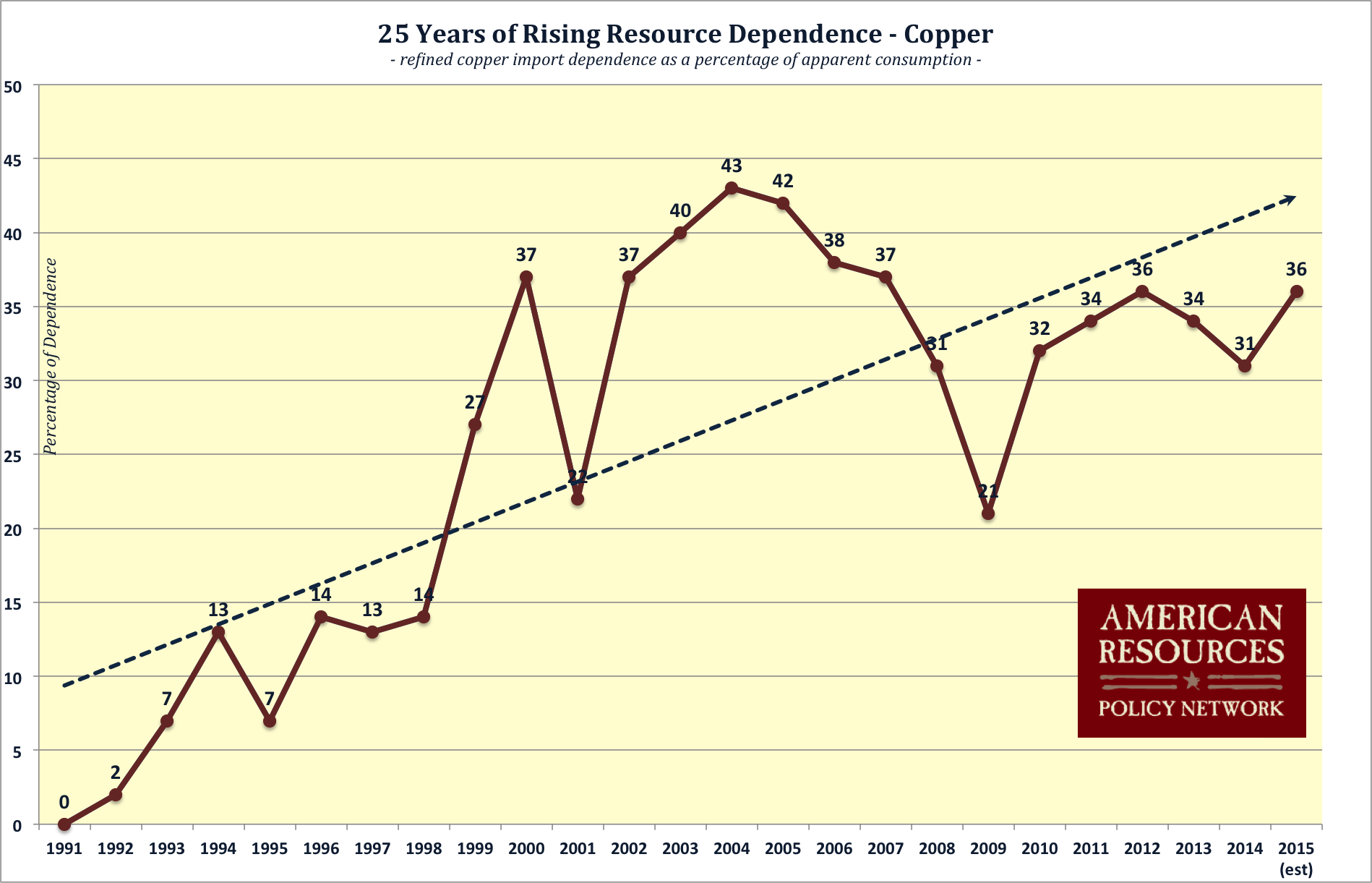
    We decided to zero in import dependence percentages specifically for our Gateway Metals, using the last 25 years of data provided by USGS in its Mineral Commodity Summaries.  A look at the trend line for our first Gateway Metal, Copper, which provides us with access to Rhenium, Molybdenum, Selenium and Tellurium confirms that the United States’ degree of import dependence for Copper has grown drastically since the end of the Cold War:

    Copper_dependence                                                                                        Source: USGS Mineral Commodity Summaries

    This needn’t be.  As we have previously pointed out, with our own reserves and at mining projects ready to come online, the U.S. would not only be able to become self-sufficient with regards to meeting Copper needs, but could even position itself to be a Copper net exporter.  In the process, the U.S. would also provide our domestic manufacturers with stable access to its co-products, which are some of the key tech metals we’ve come to rely upon to drive 21st Century innovation.

    We will review our nation’s import dependence numbers for some of the other Gateway Metals in separate posts, but a look at Copper alone makes clear that it is time for a new, more comprehensive approach to mineral resource policy.

    Share
  • Through the Gateway: Aluminum – Versatile and Timely

    After showcasing our first Gateway Metal, Copper, and its co-products, it’s time to move on to our next Gateway Metal as part of our “Through the Gateway” informational campaign. Chances are, you used it this past weekend, during and/or after your 4th of July barbecue.  It is being featured as a part of a massive art installation currently hosted by [...]
  • As Japan Retreats, US Dozes Off Again On Critical Minerals

    Over the course of the last few months, slumping prices have prompted Japanese companies to reassess their rare metals strategies and cancel cooperative agreements that were once considered a high priority. As Nikkei Asian Review reports, state-owned Japan Oil, Gas and Metals National Corp. (JOGMEC) has cancelled a joint exploration contract for a tungsten mine in [...]
  • U.S. Mineral Resource Dependency Continues to Spell Trouble

    For children, it’s the arrival of the first snow each year – for policy wonks, it’s the release of an annual study.  Whereas kids run to check the window multiple times a day once snow has been forecast, policy wonks continuously check for updates on the release of that study when it’s that time of [...]
  • USGS Rings Alarm Bell: United States’ Mineral Resource Dependencies Have Increased Drastically

    Without fanfare, and largely unnoticed at a time when all eyes in our nation’s political circles are on Iowa, the United States Geological Survey (USGS) has released a report that should be required reading for all our policy makers. Analyzing data collected from 1954 through 2014 for more than 90 non-fuel mineral commodities from more [...]
  • McGroarty/Reaugh: Time to Do Away with Uptick Rule to Unleash Canada’s Resource Sector

    The new year typically is the time for people to reflect on the preceding twelve months and make resolutions for the new year.  In an exclusive to the Vancouver Sun, our very own Daniel McGroarty, who serves on the advisory board of mining company American Manganese, joins ARPN expert and CEO of American Manganese, in reviewing 2015 as [...]
  • U.S. Forest Service Puts Damper On New Year For Wyoming

    What could have been a great start of the year for Wyoming’s economy and the United States’ critical resource needs had the U.S. Forest Service (USFS) done its job, feels more like a hangover thanks to the agency. As Laura Skaer, executive director of the American Exploration & Mining Association, writes for the Casper Star Tribune, the [...]
  • Resources in the Balance: The Concept of Compromise and the NDAA Land Exchange

    Whether it’s from our mothers or from Mick Jagger, most of us learn somewhere along the line that “you can’t always get what you want.” It’s part of a mature approach to life, and – when applied to politics – is the precursor to reaching deals that, through compromise, find a majority. A rejection of [...]
  • ARPN’s Daniel McGroarty in the Wall Street Journal

    ARPN’s Dan McGroarty reports a worrisome development in the saga of EPA’s unprecedented use of pre-emptive veto power to stop Alaska’s proposed Pebble Mine even before a mine plan is presented for review: Anti-mining activists are urging EPA to dust off its veto pen again. And again. Noting a common thread between new pushes for [...]

Archives