
-->
American Resources Policy Network
Promoting the development of American mineral resources.
  • U.S. Army Brigadier General (ret.): Congress Has Opportunity to Make “Critically Important Leap Forward to Build the Secure, Responsible Industrial Base our Economy and National Security Needs”

    In a new piece for RealClearEnergy, John Adams, U.S. Army brigadier general (ret.), argues that the newly proposed Inflation Reduction Act, negotiated by Senators Chuck Schumer (D-NY) and Joe Manchin (D-WV) is not only the most ambitious climate bill in U.S. history, but also represents an opportunity to bolster our nation’s economic and national security. 

    General Adams points to the fact that the energy components of the package, in his words, “do far more than just tackle emissions.” In his view, the provisions aim to “use the energy transition to rebuild the nation’s industrial base and ensure that the energy and transportation jobs of tomorrow are American jobs.”

    The package would require that by 2024, 40% of the minerals used in EV batteries would have to be extracted, processed or recycled in the U.S. or by a free trade partner — a requirement that increases to 80% by 2027.

    General Adams believes that the sourcing requirements for the battery “criticals” contained in the package — lithium, nickel, cobalt, manganese and graphite — are key to addressing “emerging energy security vulnerabilities before they are intractable crises.”

    He credits Sen. Joe Manchin, who believes that “trading the ugly geopolitics of petro-dictators only to sleepwalk into complete dependence on a battery supply chain dominated by China is a mistake the country cannot make,” for zeroing in on the threat Chinese dominance of critical mineral supply chains poses to the nation’s energy security.

    Followers of ARPN well know that our clean energy future hinges on massive critical mineral inputs, and demand projections for the battery criticals, but also key clean energy metals like copper, are on an ever-high trajectory.  Meanwhile, our import reliance for critical minerals is significantly up from decades ago and has shown no signs of decreasing in the past few years, with China having cornered not just the extraction, but also the processing segment of the supply chain.

    As General Adams closes:

    China has worked diligently to turn mineral supply chains into an economic leg up but also an enormous source of geopolitical leverage — not unlike how Russia has leveraged its energy trade with Europe. What Senator Manchin recognizes is that our energy future is on a collision course with our mineral insecurity and China’s mineral dominance. 

    The mineral sourcing requirements in the reconciliation bill – coupled with other incentives to encourage domestic mining, mineral processing and recycling– are precisely the bold measures needed to address this alarming vulnerability. This legislation is a critically important leap forward to build the secure, responsible industrial base our economy and national security needs.”

    Share
  • New Report Warns: Looming Copper Shortfall Could Delay Global Shift Away From Fossil Fuels

    The mainstream media and parts of the political establishment may just now have begun to realize it — but followers of ARPN have long known that our nation’s critical mineral woes are real, and go beyond the often discussed battery criticals (lithium, cobalt, nickel, graphite, and manganese) and include one of the key mainstay metals: Copper.

    Less flashy and headline-grabbing than some of its tech metal peers, copper deserves far more credit and attention than it is currently receiving. ARPN has long touted copper’s versatility stemming from its traditional uses, new applications and Gateway Metal status.

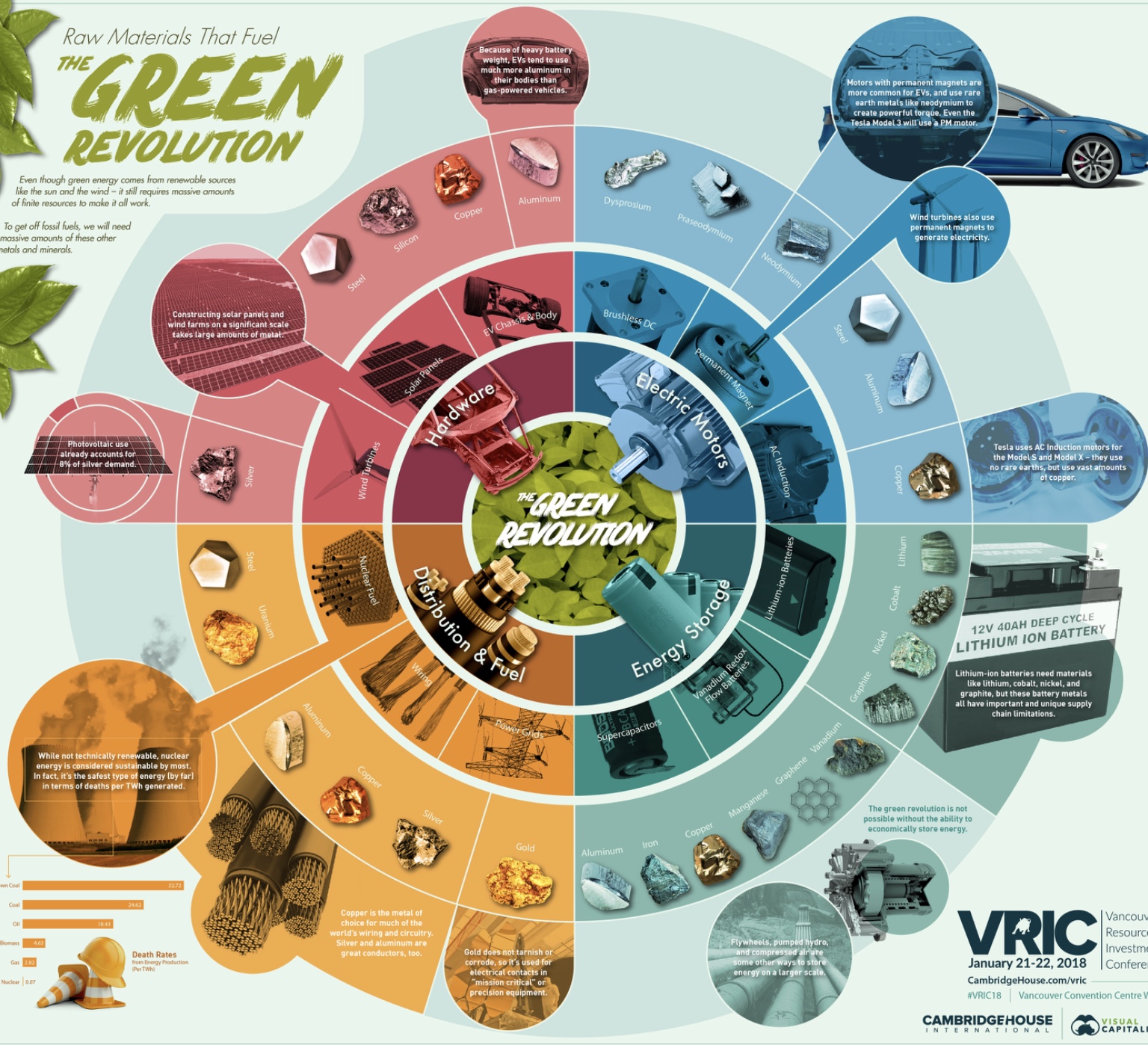
    A quick look at a 2018 Visual Capitalist chart also makes unmistakably clear that copper is also an irreplaceable component for advanced energy technology, ranging from EVs over wind turbines and solar panels to the electric grid, and as such an indispensable building block of the green energy transition:

    5F5E0C59-4112-4C46-B858-CB45D5725666

    Copper — and its mainstay metal peer aluminum — are to be found in all four categories, hardware, electric motors, distribution & fuel and energy storage. The average EV requires four times more copper than gas powered vehicles, and the expansion of electricity networks will lead to more than doubled copper demand for grid lines, according to the IEA.

    Consequently, it should not come as a surprise that a new report has taken a closer look at the copper supply picture in the context of the global push toward net zero carbon.

    As reported by Bloomberg, a new S&P Global study “warns of ‘unprecedented and untenable’ copper shortfalls in the coming decade as suppliers grapple with a near doubling of demand by 2035. Prices that fell below $7,500 this week are seat to soar back above their $10,845 peak later this decade, driven by the metal’s key role in the clean-energy and transport industries.”

    Current market slowdowns notwithstanding, forecasts see long term demand reaching around 50 million tons by 2035 from 25 million today, and an annual supply shortfall of almost 10 million tons could open up in 2035 according to the study — which would amount to the “equivalent to 20% of demand projected to be required for a 2050 net-zero world.”

    The “burgeoning supply gap would increase the US’s reliance on copper imports from 44% to as much as 67% by 2035,” writes Bloomberg. Ultimately, supply shortages could become “so severe and prices so high in coming years that they risk delaying the global shift away from fossil fuels.”

    As the Wall Street Journal pointed out earlier this year, there is no easy way out of the critical mineral resource challenge, as “years of underinvestment in new mines means they don’t have additional production that can be brought on quickly. After a decadelong focus on productivity, existing operations are mostly running at full tilt. Difficulties in getting permits to build pits and community opposition have slowed developments in some countries, and scuttled projects in others.”

    And, as Laura Skaer, a member of the board of directors of the Women’s Mining Coalition and former director of the American Exploration & Mining Association, outlined in a piece for Morning Consult last summer, the challenge is not just mining, but also processing:

    “Last year, the United States imported 37 percent of the copper we used. China already refines 50 percent of the world’s copper and the United States only refines about 3 percent. National security experts have warned that relying on China for critical supply-chain materials like refined copper poses a serious threat to America’s national security interests.”

    However, as we previously argued,

    “from a U.S. supply perspective, there is reason to be optimistic. While snubbing the material again for its updated Critical Minerals List, the Biden Administration has recognized copper as an integral component of Lithium-ion battery technology, in the context of being what we have called a ‘gateway metal‘ to other critical materials, and for its ‘use across many end-use applications aside from lithium-ion cells, including building construction, electrical and electronic products, transportation equipment, consumer and general products, and industrial machinery and equipment’ in its 100-Day Supply Chain Review report.

    Coupled with new reports that ‘US regulators are warming to approving new domestic sources of electric vehicle battery metals, as Washington bids to avoid a reliance on strategic minerals imports similar to that on crude oil,’ this is an encouraging development.”

    Thankfully, the private sector is ready to step up to the plate, harnessing advances in materials science and technology to help develop critical mineral resource supplies while maintaining and advancing sustainable mining practices. With the stakes ever-increasing, now is the time to unleash our nation’s mineral potential.

    Share
  • Beyond the Rare Earths and Battery Criticals – U.S. Armed Services Committee Seeks to Address Supply Chain Challenges for Antimony

    Underscoring the growing awareness that our nation’s overreliance on foreign supplies of critical minerals underpinning 21st century technology stretches beyond the much-discussed Rare Earths and battery criticals lithium, cobalt, nickel, graphite, and manganese, the U.S. House Committee on Armed Services has released draft legislation to address China’s stranglehold on the supply chain for antimony. Used [...]
  • “Critical” Without the Label? – A Look at Boron

    While critical mineral resource policy is finally receiving the attention it deserves against the backdrop of increasing supply chain challenges, a look at the materials stealing the spotlight would have you believe the list of metals and minerals deemed critical from a U.S. national and economic security perspective is much shorter than it is. The [...]
  • As Stakes Continue to Get Higher, Critical Minerals Challenge Goes Mainstream with Realization Issue Goes Beyond “Battery Criticals”

    Supply chain challenges in the wake of the coronavirus pandemic, Russia’s war on Ukraine, rising resource nationalism in the southern hemisphere, and now China’s Xi Jinping doubling-down on its zero-Covid policy this week which may lead to more lockdowns with serious economic and trade consequences – critical mineral supply chains can’t seem to catch a break. As [...]
  • Russia’s War on Ukraine and Rising Resource Nationalism to Reshape Global Post-Cold War Order and Resource Supply Chains – A Look at Cobalt

    With a single electric vehicle battery requiring between 10 and 30 pounds of cobalt content, the lustrous, silvery blue, hard ferromagnetic, brittle nickel and copper co-product has long attained “critical mineral” status. However, with most global supplies of the material coming from the Democratic Republic of the Congo, where mining conditions often involve unethical labor standards and [...]
  • U.S. Senators to President Biden: With Stakes Raised, Time to Invoke the Defense Production Act to Secure Critical Mineral Supply Chains

    Already severely strained by the coronavirus pandemic, global critical mineral resource supply chains have taken another hit with Russia’s full-fledged invasion of Ukraine.  With no de-escalation of hostilities in sight, Western nations, including the United States, are stepping up their efforts to bolster domestic supply chains, not only for oil and gas, but also for non-fuel [...]
  • The Stakes Just Got Higher – The State of U.S. Critical Mineral Resource Security

    Set to deliver his first State of the Union address today (March 1, 2022), U.S. President Joe Biden will likely have to tweak the outline for his speech considering the latest developments in Ukraine, and the resulting implications for the United States, and the world as a whole. Against growing tensions, we recently highlighted mounting [...]
  • Time for a Reckoning at “Ferrari Supercar Speeds” – It’s Not Just Battery Materials: A Look at Aluminum

    In recent months, industry news has been dominated by headlines like “carmakers face raw material bottleneck.” And while, rightfully, against the backdrop of the accelerating green energy transition and EV revolution, much of the coverage focuses primarily on supply chain challenges arising for the battery criticals Lithium, Cobalt, Nickel, Graphite and Manganese, it’s not just the [...]
  • USGS Mineral Commodity Summaries 2022 — Amidst Greater Focus on Supply Chain Security, Mineral Resource Dependence Persists

    We’ve named it the year of the Supply Chain, noting that others said “2021 is the year ‘supply chain’ went from jargon to meme.” While an increased focus on the supply chain was undoubtedly a critical development in the mineral resource realm, and several steps to increase supply chain security for critical minerals were taken in [...]

Archives