
-->
American Resources Policy Network
Promoting the development of American mineral resources.
  • As Biden Administration Doubles Down on EV Adoption Push, U.S. Must Double Down on Comprehensive “All-of-the-Above” Critical Minerals Strategy

    The Biden Administration has announced the “most aggressive” plan to curb tailpipe emissions to date, with new vehicle pollution standards proposed by the Environmental Protection Agency (EPA) and announced by the White House last week.

    If finalized, the proposed rules would require automakers to reduce carbon emissions by 56% in their 2032 models compared to 2026 models.  The expectation is that with the rules in place, 67% of new light-duty car purchases will be electric by 2032.

    The move comes at a time when geopolitical and trade tensions between the United States and our allies on one hand, and China on the other are soaring, and observers argue that the ambitious plans could play into Beijing’s hands.

    While the United States has taken several important steps to decouple its critical mineral supply chains from China, Beijing, having systematically built out its dominance across the entire value chain from mining over processing to manufacturing, still has a chokehold on the EV battery supply chain, and the latest USGS Mineral Commodity Summaries report confirmed that for all of the recent U.S. policy efforts, our dependencies still persist.

    In case anyone needed a reminder, here is an infographic from last November, compiled by our friends at Benchmark Mineral Intelligence clearly visualizing China’s dominance of the battery supply chain.
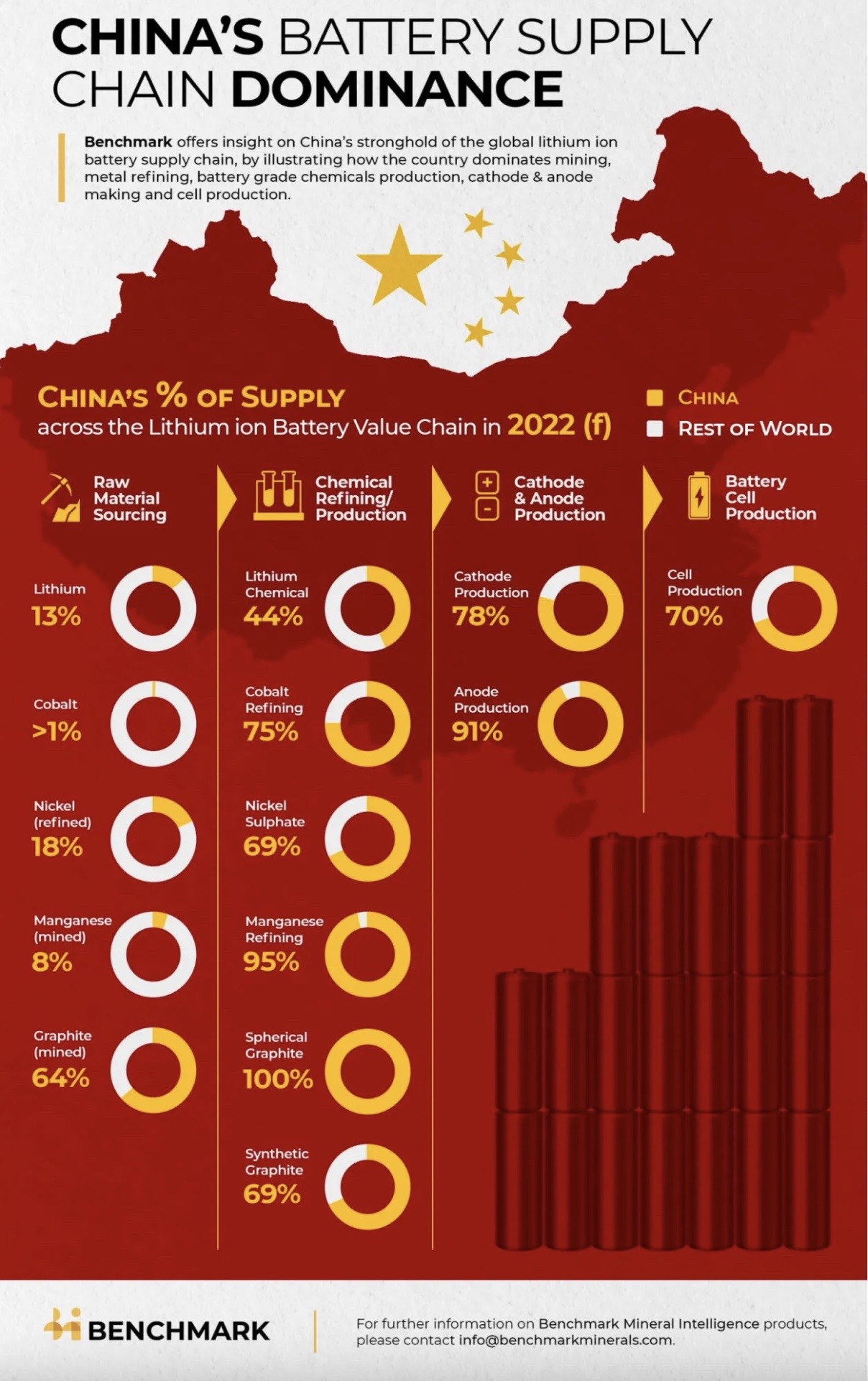
    Image 10-31-22 at 10.59 AM

    The Biden Administration has, in recent weeks, stepped up its friend-shoring initiatives to bolster U.S. supply chains, with recent trade deliberations having yielded a free trade Critical Minerals agreement with Tokyo and a likely similar accord between the U.S. and EU. U.S.-Canadian critical minerals cooperation has also seen a boost.

    Embedded into a comprehensive “All of the Above” strategy, these friend-shoring initiatives can play an important role in strengthening critical mineral supply chains.  And yet there are mounting concerns that the Biden Administration, in spite of verbal affirmations of wanting to responsibly expand domestic resource development and processing, continues to cater to the “not-in-my-backyard” sentiment, which still runs strong in discussions on resource development.

    This brings us back to the “inherent irony” or “paradox of the green revolution” Reuters columnist Andy Home has invoked in several instances when covering critical mineral resource supply chains for the very materials underpinning the green energy transition — the paradox that “public opinion is firmly in favour of decarbonisation but not the mines and smelters needed to get there.”

    It’s not that there is a lack of promising domestic resource development projects, especially for the Battery Criticals — lithium, cobalt, graphite, nickel, and manganese.

    ARPN recently looked at each of these materials, now deemed under President Biden’s DPA determination to be “essential to the national defense,” and the U.S.-based projects working to urgently needed new supply into production. [See our discussions linked here: LithiumCobaltGraphiteNickelManganese]

    And let’s not forget copper, which has increasingly been recognized – most recently by the EU — as a critical raw material in light of its key role in the green energy transition, and for which a push to have the metal added to the U.S. Government Critical Minerals List is currently underway.

    As ARPN has previously pointed out, lofty goals of net carbon neutrality – and that includes the just released proposed EPA emission standards –  will not be achievable if we don’t embrace a push to secure critical mineral supply chains from “soup to nuts” to borrow a term used by Energy Secretary Jennifer Granholm.

    After all, as we’ve noted often at ARPN, the first word in supply chain is… supply.

    Share
  • As Global Tensions Rise, the Buildout of an Integrated North American Critical Minerals Supply Chain is Coming into Focus

    Amidst growing tensions between the United States and China, the United States is stepping up its friend-shoring efforts in an attempt to diversify its critical mineral supply chains. Recent trade deliberations with Japan and the European Union have yielded a free trade Critical Minerals agreement to strengthen supply chains with Tokyo and will likely lead to a similar accord between Washington, DC and Brussels.

    Perhaps the most natural ally for the United States, is to our north – Canada.

    Both countries have in recent years explored ways to partner up in their efforts to secure critical mineral supply chains, and have deepened and formalized their cooperation in this field in the context of the 2020 Canada-U.S. Joint Action Plan on Critical Minerals and various multilateral forums, including the Sustainable Critical Mineral Alliance launched at the end of last year, and the Minerals Security Partnership launched in June of 2022.

    While many country-to-country communiques never make it past the bureaucratic boilerplate, the U.S.-Canadian relationship is “more than metaphorical” and “[u]nlike any of America’s other allies, Canada has long been part of a special relationship, linking the two country’s defense industrial bases as one” with the defense union dating back to the months preceding America’s entry into World War II, as ARPN’s Daniel McGroarty phrased it in a 2018 piece for Investors Business Daily. 

    In a plea for greater bilateral critical minerals cooperation in the fall of 2021, former U.S. ambassador to Canada David Jacobson wrote in the Globe and Mail:

    “We are in a race against time, and we cannot always count on the competition to play fair. Americans and Canadians have historically pulled together for the good of both nations in times of challenge. Such times are coming. Let’s once again plan for, face and beat this new challenge by together establishing our place in the global supply chain.” 

    His call was echoed by U.S. Senator Joe Manchin (D-WV), who in the summer of 2022 suggested that the U.S.-Canadian energy and critical minerals partnership be strengthened “to ensure [the] free world’s energy security and address climate change.”

    The bilateral partnership has been given a new boost with President Joe Biden’s visit to Ottawa last month, during which President Biden and Canada’s Prime Minister Justin Trudeau celebrated the two countries’ “progress under the Roadmap for a Renewed U.S.-Canada Partnership over the past two years and reaffirm our historic alliance, steadfast friendship, and commitment to overcome the daunting challenges of today and realize the full potential of the relationship in the future.”

    The Joint Statement by President Biden and Prime Minister Trudeau specifically affirmed both parties’ commitment to creating “a strong, environmentally responsible and resilient North American critical minerals supply chain,” and the mutual goal of “identifying, securing and developing critical minerals extraction, processing, manufacturing, and recycling opportunities in both countries to diversify supply chains essential to clean energy, electric vehicles, semiconductors, aerospace, and defense, among other sectors (…).”

    It further announced that the recipients of the $250 million of Defense Production Act Title III funding to mine and process critical minerals for electric vehicle and stationary storage batteries would include both U.S. and Canadian companies to be announced this spring.

    With geopolitical tensions on the rise, the trade dimension of critical mineral resource policy is coming more and more into focus and the importance of building an integrated North American supply chain is increasing.  However, as ARPN and others have consistently argued, the United States cannot just rely on partners to meet U.S, critical mineral needs, the United States “also needs to contribute our part to a North American minerals alliance”, as Sen. Manchin phrased it.

    As ARPN previously argued:

    “Let’s do it. Let’s build out an integrated North American supply chain for critical minerals where possible — but let’s also not forget that closer cooperation with our friends and allies AND strengthening domestic resource development should not be considered mutually exclusive strategies.”


    Share
  • Inflation Reduction Act Spurs Trade Agreement Between USA and Japan, Deal with EU Likely to Follow Soon as Treasury Releases Clarifying Guidance

    The Inflation Reduction Act (IRA), passed and enacted into law last year, is considered one of the landmark pieces of legislation to combat climate change and strengthen U.S. critical mineral supply chains. The package included funding for tax credits and rebates for consumers buying electric vehicles, installing solar panels or making other energy-efficiency upgrades to their homes, [...]
  • EU Critical Mineral Supply Chain Action Plan Focuses on Permitting, Adds Copper and Nickel to List of Critical Raw Materials

    With demand for critical minerals projected to increase dramatically against the backdrop of geopolitical tension and strained supply chains, the European Union has released its long-awaited action plan to “ensure the EU’s access to a secure, diversified, affordable and sustainable supply of critical raw materials.” The Critical Raw Materials Act (CRMA) presented to lawmakers in Brussels on March [...]
  • Tech Arms Race to Heat Up as Western Nations Take Steps to Counter China on Semiconductors, Critical Minerals

     Semiconductors have become indispensable components for a broad range of electronic devices. They are not only “the material basis for integrated circuits that are essential to modern day life” – the “‘DNA’ of technology” which has “transformed essentially all segments of the economy,” they are also essential to national security, where they enable the “development and fielding of advanced weapons systems and [...]
  • New Push to Bolster Critical Mineral Supply Chains to Shore Up Industrial Base Focuses on Permitting, Banning “Bad Actors”

    In a guest editorial for the Pennsylvania-based Patriot News, Gen. John Adams, a retired U.S. Army brigadier general, president of Guardian Six Consulting and a former deputy U.S. military representative to NATO’s Military Committee, writes that the war in Ukraine, following on the heels of a pandemic that unearthed massive supply chain challenges across many [...]
  • This Week’s Dramatic Development: The Rise of the “Defense Criticals”

    by Daniel McGroarty The Critical Mineral space in the U.S. experienced a dramatic development this week, largely overlooked beyond specialty reporting in the defense and energy media:  With his February 27, 2023 Presidential Determination, President Biden once more invoked Title III of the Defense Production Act (DPA) to strengthen critical mineral supply chains – and in doing [...]
  • Bolstering the Domestic Supply Chain for “Battery Criticals” – A Look at Cobalt

     In this post, we continue our review of the “battery criticals” (lithium, cobalt, graphite, nickel and manganese) against the backdrop of the just-released 2023 iteration of the USGS Mineral Commodity Summaries.  Next up:  cobalt. With the material accounting for up to 20% of the weight of the cathode in a typical lithium-ion EV battery, cobalt was considered the highest [...]
  • As U.S. Chinese Tensions Soar, Congressional Witnesses Call for Strengthening U.S. Defense Industrial Base and Domestic Critical Mineral Supply Chains During Armed Services Committee Hearing

    If we needed any more reminders about the high-stakes nature of our ongoing (see ARPN’s post on the latest USGS Mineral Commodity Summaries report here) deep over-reliance on Chinese-sourced (and/or processed) critical minerals, the shooting down of a Chinese spy balloon in U.S. airspace and the subsequent downing of three other unidentified flying objects over Alaska [...]
  • As Critical Mineral Dependencies Persist, Promising “Battery Criticals” Projects Provide Opportunity to Ensure that “the Supply Chain for America Begins in America” – A Look at Graphite

     For all the talk about reducing our over-reliance on foreign critical mineral resources against the backdrop of soaring demand, strained supply chains and increasing geopolitical tensions, last week’s release of the annual USGS Mineral Commodity Summaries report still paints a sobering picture. While the number of metals and minerals for which the U.S. remains 100% import dependent [...]

Archives