
-->
American Resources Policy Network
Promoting the development of American mineral resources.
  • Biden Administration 100-Day Supply Chain Report Holds Surprise for Some: And the Winner is… Nickel?

    Critical Minerals policy-wonks:  if you wagered that Rare Earths would be the leading elements in the Biden 100-Day Report in terms of mentions, you’d be wrong.

    That’s right — we took a look at the Biden Administration’s just-released 100-day supply chain assessment, and created a word cloud based on the number of mentions (footnotes included) of the metals and minerals that made the official U.S. Government Critical Minerals List of 2018 — and the two that didn’t but should have (Nickel and Copper).

    Here’s what it looks like:
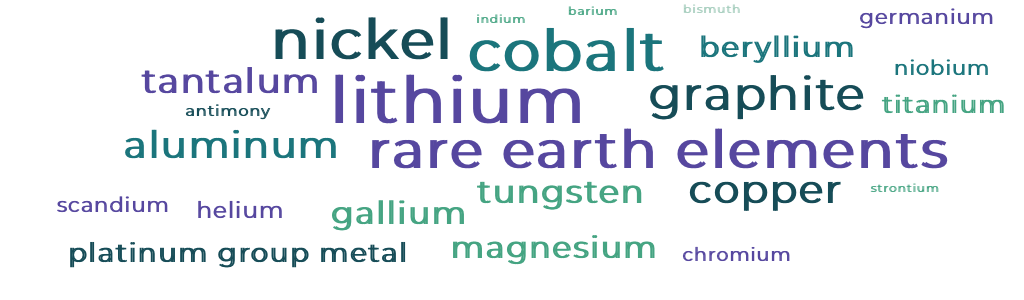
    EA75ED84-A679-4D0B-B842-602873A2DB9DIt may come as no surprise that Lithium and Cobalt are prominently featured (Lithium is mentioned 315 times and Cobalt appears 167 times) — after all we find ourselves in a “battery arms race.”

    And, of course, the Rare Earths made the cut with 105 mentions[1], but what may surprise you is that Nickel — a non-Critical, at least in terms of the official U.S. Government Critical Minerals List of 2018 – takes the bronze with a whopping 146 references.   And fellow non-Critical Copper also racks up a Top Ten appearance, with 29 references.

    In the Department of Energy-led supply chain assessment chapter, DoE notes under the Nickel sub-header for “Mapping the Supply Chain” that “if there are opportunities for the U.S. to target one part of the battery supply chain, this would likely be the most critical to provide short- and medium-term supply chain stability.”

    DoE continues:

    “In contrast to cobalt, nickel content per battery will increase in the coming years, as R&D focused on high-nickel in cathodes has shown significant and accelerated commercial adoption. The potential shortfall from this increase in demand poses a supply chain risk for battery manufacturing globally, not just in the United States; given the pervasive need, the established nickel industry is ramping up production and processing, and the United States is falling further behind China in this critical material.”

    Copper is highlighted in the 100-Day Report as an integral component of Lithium-ion battery technology, in the context of being what we have called a “gateway metal” to other critical materials, and for its “use across many end-use applications aside from lithium-ion cells, including building construction, electrical and electronic products, transportation equipment, consumer and general products, and industrial machinery and equipment.”

    ARPN followers can claim an I-told-you-so here.  After all, ARPN’s Daniel McGroarty urged the U.S. Government to include both Nickel and Copper in the 2018 official government list of critical minerals in his Public Comment submission.

    With that brief moment of vindication, let’s move on to say that the Biden Administration is right to give prominence to Nickel and Copper in its strategy.

    As Reuters’s Andy Home points out,

    “Nickel isn’t on the U.S. list of critical minerals. Although the country depends on imports, 68% of supplies come from what the report calls “allied nations” such as Canada, Australia, Norway and Finland.

    But the Department of Energy (DOE) has identified Class 1 nickel, the type best suited to lithium-ion batteries, as both a key vulnerability and key opportunity. (…)”

    As the White House 100-Day Report notes:

    “Eagle Mine is the only active nickel mine in the U.S. today, and its lifetime is set to end in 2025.”

    Home acknowledges this fact and continues:

    “There is no domestic nickel processing capacity outside a limited amount of by-product salt production.

    Yet this particular battery metal is the one likely to experience the most significant demand increase over the coming years, the report says, with ‘market indications that there could be a large shortage of Class 1 nickel in the next 3-7 years.’

    Indeed, with nickel content rising in battery cathode design, not having enough of the right kind of nickel ‘poses a supply chain risk for battery manufacturing globally, not just in the United States.’”

    For Copper, one need to look no further than the latest IEA report which estimates that, driven by the Electric Vehicle revolution, copper demand will be 25 times greater in 2040 than it was in 2020.

    Thankfully, the U.S. does not have to look far for opportunities to strengthen our position for both Nickel and Copper. The Tamarack Nickel project in Minnesota hosts a high-grade Nickel deposit, along with Copper and Cobalt as co-products.  As for Copper, several of our recent posts provide an insight into domestic opportunities.

    As the Department of Energy concludes:

    “The United States must adopt a set of tools to increase domestic battery manufacturing while improving the resilience of the lithium battery supply chain, including the sourcing and processing of the critical minerals used in battery production.”

    It’s a behemoth task, but, the good news is that  in light of the United States’ mineral riches and technical knowhow the “All of the Above” approach embraced in the Biden Administration’s strategy can start at home.


    [1] For the purpose of this word cloud, we counted all mentions of “Rare Earth(s)” as a group in both text and footnotes. We did not include mentions of the individual rare earth elements with the exception of Scandium, which is also treated separately by the 2018 official U.S. Government list of 35 critical minerals. Note that our word cloud generator left off several of the 35 critical minerals because they were either not mentioned at all or received very few mentions.

    Share
  • “Keep It In The Ground” Too Simplistic — We Need Holistic “All of the Above” Approach to Critical Minerals

    After several positive steps indicating an openness towards a holistic “all of the above” approach on critical minerals, it appears that the Biden Administration may be backpedaling.

    As Reuters reported earlier last week, the Administration is planning to “rely on ally countries to supply the bulk of the metals needed to build electric vehicles and focus on processing them domestically into battery parts, part of a strategy designed to placate environmentalists.”

    Described by Reuters as a “blow to U.S. miners who had hoped Biden would rely primarily on domestically sourced metals, as his campaign had signalled last autumn,” the Biden plan would reportedly focus on processing rather than “digging a hole.”

    In a piece for the Deseret News, several weeks before the Reuters story, Thom Carter, energy adviser to Utah Gov. Spencer Cox and executive director of the Governor’s Office of Energy Development, outlined the pitfalls of the “keep it in the ground” mantra the Biden administration appears to be succumbing to, and how an “all of the above” energy strategy has helped Utah thrive.

    Writes Carter:

    “This [all of the above] policy has served Utahns well. We have some of the lowest energy costs in the country. Our energy sector provides good jobs with high wages. According to the Utah Department of Workforce Services and the U.S. Bureau of Labor Statistics, the Utah energy sector had the second-highest paying jobs of any sector in the state in 2019, with the tech and information sector coming in higher by a very small margin.”

    He cautions that the “keep it all in the ground” push by “Washington, D.C. and the East and West Coasts” provides little more than a “talking point,” but that “anyone who says that you can get power through a ‘keep it in the ground’ policy isn’t telling you the truth. (…) All power, whether traditional or renewable, is impacted by what comes out of the ground. Advocating for renewable energy sources also means maintaining, if not expanding, our mining infrastructure.”

    Recent studies — we featured the latest IEA study here — and policy experts agree: against the mounting pressures of the 21st Century Tech Metals Age, keeping it all in the ground is too simplistic, and a holistic “all of the above” approach to energy and critical minerals is the only viable path to success.

    Share
  • To-Be-Devised Rare Earths Policies Should Tie Into Broader “All of the Above” Approach to Critical Mineral Resource Policy

    As the Biden Administration doubles down on its ambitious climate and technology agenda, it becomes increasingly clear that the issue of material inputs underpinning a green energy transition must be addressed. Followers of ARPN know — not least since last year’s World Bank report or last week’s IEA report — that massive supplies of EV [...]
  • Infrastructure Reform Done Right Will “Recognize and Elevate the Importance of American-Produced Raw Materials”

    The crumbling state of our nation’s infrastructure is neither a secret, nor is addressing it a small task, as today’s infrastructure stretches far beyond bridges, roads and ports. As ARPN’s Daniel McGroarty phrased it a few years back: “It’s not your Grandfather’s infrastructure anymore.” U.S. President Joe Biden is right to call out and address [...]
  • Commentary: Fighting Global Climate Change Through Electrification is a Herculean Task

    In a new piece for Forbes, Jude Clemente, principal at JTC Energy Research Associates, LLC, outlines the size and scope of the ambitious climate goal of electrification to fight climate change, and discusses the underlying challenges associated with the shift. Clemente argues that the likely surge in electricity demand as the world seeks to decarbonize [...]
  • Podcast: Battery Tech Supply Chain Expert Simon Moores Discusses Lithium Challenge

    American Jobs Plan, Green New Deal … irrespective of whether these plans will get implemented fully or in part, the renewable energy transition is already here, and it’s here to stay. The renewable energy sector has been transforming at neck-breaking speed, and with that, demand for the metals and minerals underpinning the green energy shift [...]
  • “Sustainably Greening the Future” Roundup – Mining and Advanced Materials Industries Harness Materials Science in Green Energy Shift

    The Biden Administration has shifted focus to its next major legislative priority in the context of the president’s “Build Back Better” agenda — a multi-trillion dollar jobs and infrastructure package. Billed as a plan to make the economy more productive through investments in infrastructure, education, work force development and fighting climate change, the package will [...]
  • A Look North: Challenges and Opportunities Relating to Canada’s Critical Mineral Resource Dependence on China

    Like the United States, Canada has subjected itself to an “increasingly uncomfortable reliance” on China for critical mineral supplies, but its wealth of metals and minerals beneath the country’s soil could, if properly harnessed, give Canada a significant strategic advantage in years to come, mining executives and experts recently told Canada’s House of Commons resource [...]
  • The Road to “Building Back Better” is Paved with Critical Metals and Minerals

    Another round of COVID relief stimulus checks is hitting Americans’ bank account this week, and a vaccine schedule laid has been laid out. Time for the Administration and Congress to move on to the next key priority of the Biden Administration’s “Build Back Better” agenda: an economic recovery package that will “make historic investments in [...]
  • Sec. Granholm, DoE Embrace Domestic EV Mineral Production “So Long As It Is Done Sustainably”

    With the “battery arms race” turbocharged by the coronavirus pandemic, observers are concerned that Lithium ion batteries could become “geopolitical hot potatoes.” In light of these developments, the latest statements from newly-confirmed Secretary of Energy Jennifer Granholm, coupled with the recently-signed executive order on strengthening U.S. supply chains, are encouraging indications that the new Administration [...]

Archives