-->
American Resources Policy Network
Promoting the development of American mineral resources.
  • Race for Seabed’s Mineral Riches Heats Up

    The global race for resources is heating up, with the latest frontier being the seabed beneath the world’s oceans. Last year’s discovery of significant Rare Earth deposits by Japanese researchers on the seabed of the Pacific Ocean seems to have set of a flurry of activity on the part of countries trying to gain access to what is considered a treasure trove of metals and minerals. Not surprisingly, China, which is engaging in a global quest to gain access to critical mineral resources, threw its hat in the ring earlier this year, with a goal to develop its deep-sea mining technology by 2030.

    Not to be outdone, and concerned that “China’s deep-sea excavations will further increase China’s dominance over rare-earth elements,” India has reportedly made the decision to spend roughly $135 million on a new exploration ship and to retool another vessel for another for “sophisticated deep-water exploration off its coast.”

    According to the Science and Development Network, the seabed in the region holds promise for Nickel, Copper, Cobalt and potentially Rare Earths exploration.

    New Zealand, too, is mulling seabed exploration efforts according to the New Zealand Herald, with the seabed around the country’s shores containing Iron, Manganese, Gold, Silver, Copper and Zinc, among others.

    With more and more countries jumping into the fray, deep-sea mining is beginning to sound less and less like a chapter of a Jules Verne novel. However, it is not, as some were quick to conclude last year, the silver bullet to (China-induced) mineral supply woes. Environmental concerns aside – technological challenges and the political question of who owns the seabed “commons” still loom large, and would dictate that in order to secure access to critical mineral resources, the immediate focus should be placed on the mineral riches we are blessed to have beneath our own soil.

    Share
  • China Tinkers With Rare Earth Policy While U.S. Delays Critical Mining Projects

    China has announced a series of moves designed to place additional controls on global rare earth metal supply. Meanwhile, U.S. Federal and state policymakers continue to dither over domestic mining policy initiatives.

    According to the National Mining Association, the US has $6.2 trillion dollars of mineral reserves, but it also has one of the slowest permitting processes in the world for new mines, running on average 7-10 years. As China’s influence swells, America’s dependence on foreign sources of supply becomes a greater cause for concern.

    China’s New Policies

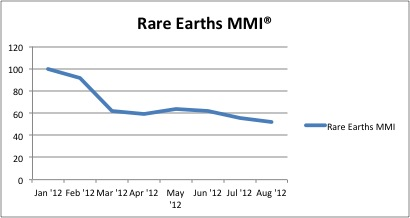
    According to MetalMiner IndX(SM), the Rare Earths MMI®, a price index for Chinese Rare Earth metals fell 10 points since June 1, 2012 and 48 points since January of this year.


    Source: MetalMiner IndX(SM)

    This is attributable to falling domestic demand in China, and Beijing has made several policy changes within its rare earth manufacturing sector to stabilize prices. These reforms will place additional pressure on the U.S. and all other countries that rely on China for rare earths.

    The first announcement came approximately 45 days ago, indicating that China would begin stockpiling rare earth metals. China has successfully moved global markets for a range of metals through stockpiling, particularly when it comes to copper and zinc. China’s copper stockpile (1.9 million metric tons) is more than the U.S. consumes in an entire year.

    Copper is an extremely valuable metal due to its extensive security, technology and energy applications. It is the second-most used material by the U.S. Department of Defense. Copper is also the primary mineral for other critical and strategic minerals, such as Molybdenum, Rhenium, Tellurium, and Selenium. China’s stockpiling has reduced the availability of global supply, boosting demand and the price in turn.

    According to intelligence group Stratfor, citing China National Radio and Xinhua, Chinese authorities have set a minimum production threshold on rare earth producers which will have the effect of reducing output by 20 percent. The Stratfor report also quoted a Chinese ministry official as saying the new thresholds may shut down one-third of rare earth mining operators and potentially half of smelting and metallurgy businesses involved in the rare earth mining sector. This strategy will further shore up prices and demonstrate China’s market power when it comes to rare earth metals.

    Finally, China has just announced it will begin publishing a rare earth metal price index, ostensibly to create greater visibility into price trends for these metals (though how this index will benefit Chinese producers remains unclear).

    U.S. Manufacturing Needs Smart Minerals and Metals Policies

    These developments underscore the near stranglehold China has on the global supply of rare earth metals. When China keeps the price of these raw materials high, it increases costs for US manufacturers and hampers our economy, from the national down to the local level. Players in key manufacturing states, such as Wisconsin, are looking for smarter regulations and policies that allow the minerals and metals industry to give American manufacturing the boost it needs.

    During a recent manufacturing summit in Milwaukee, hosted by the Metal Service Center Institute, its President and CEO Bob Weidner hosted a panel made up of executives from several metal companies including executives from Brillion-based Ariens Company, Chicago-based Lapham-Hickey Steel Corp., Dalco Metals Inc. of Walworth, Nucor and Bucyrus International. The panel addressed questions around policies that would boost job creation and improve manufacturing prospects for the US. The most frequent answers, as quoted from The Business Journal, included “simplifying and reducing taxes, less strict regulations that still protect the environment, developing a national energy policy, enforcing international trade laws with China and passing a federal debt plan so the country doesn’t go the way of Greece.”

    Job creation goes hand in hand with sound government policy. Ironically, some of these manufacturing policies require little to no money to implement (e.g. streamlining the permitting process does not require new government expenditures) but they take coordinated action and a willing executive and legislative branch to implement.

    Share
  • EPA overregulation could cost U.S. $220 billion in investment

    The Daily Caller reports that the EPA’s preemptive assessment of the Pebble copper and gold mine in Alaska could cost the U.S. $220 billion in investment. The agency’s report, based on an evaluation of a hypothetical mine, expresses concern over the site’s potential environmental impact and could lead to Pebble’s rejection before it has a [...]
  • European wind farms fuel copper demand

    Underscoring once more that technological progress continues to change the utility of metals and minerals, and that today’s mainstay metals may be tomorrow’s specialty metals, European wind farms are driving up copper demand. According to a Reuters story, research consultant Wood Mackenzie expects “copper use in wind turbines to rise 15 percent between 2013 and [...]
  • Critical Minerals, national security and EPA overreach

    In a new column featured on the Cleveland Plain Dealer’s website, American Resources principal Daniel McGroarty discusses the latest American Resources report on Critical Minerals & National Security in the context of the U.S. Environmental Protection Agency’s latest manifestations of regulatory overreach. Here are his key points: The EPA’s activist approach to regulating natural resource [...]
  • China to accelerate overseas pursuit of nonferrous metals

    As reports about China’s restrictive mineral export policies continue to dominate the resource news cycles, don’t expect Beijing to slow down its aggressive pursuit of access to critical metals and minerals around the world. According to China Daily’s European edition, senior Chinese industry officials have announced that Chinese miners will accelerate the exploration of overseas [...]
  • China’s African resource footprint continues to grow

    China’s aggressive pursuit of mineral resources around the globe continues with Africa being a “key destination for meeting China’s resource acquisitiveness,” according to a presentation given at the Coaltrans Southern Africa conference earlier this month. As outlined in an article on MiningWeekly.com, China’s quest for resources in Africa, which centers on oil, gold, platinum, copper, [...]
  • Copper mining boon to state and local economies

    Two copper mines in Silver City, New Mexico are proving to be a real boon to the local economy. Employment at the Chino and Tyrone copper mines has increased dramatically since 2009 thanks to increased production, with the Chino mine now employing 1,500 people. The economic benefit, however, stretches beyond local families and businesses profiting [...]
  • Review of Bristol Bay Watershed in Alaska: Is EPA Reaching for the Kill Switch?

    Sounding the alarm on the possible impact of hypothetical mining — in spite of the fact that no permit application or specific plans have been submitted — the Environmental Protection Agency (EPA) has released a cursory review of the Bristol Bay Watershed in Alaska. The EPA’s unprecedented early action is part of the agency’s effort [...]
  • American Resources Policy Network Strategic Minerals Conference 2012

    International control over mineral resources and the need for stable domestic supplies ranging from rare earths to copper is quickly becoming a powerful national defense issue that could shape the balance of power for decades to come. On June 6th, leaders from industry, military, and policy arenas will come together to identify core obstacles and [...]

Archives