
-->
American Resources Policy Network
Promoting the development of American mineral resources.
  • Green Energy Shift Requires a Revolution in Materials Science

    As the global push towards a carbon neutral future accelerates, it is also becoming increasingly clear that the green energy shift will be mineral intensive, as a score of critical metals and minerals underpin 21st Century green energy technology. It’s not too much to say that shifting green depends on a revolution in materials science.

    Acknowledging their responsibility, the mining sector and associated industries have made significant capital investments and have been harnessing the materials science revolution to meet increased expectations of consumers, society and governments to sustainably and responsibly support the shift.

    On a broader level, in a recent post, Seeking Alpha points to the European Copper Institute having found that the “copper industry reduced CO2 emissions by 60% from 1990 to 2020 by investing in efficiency and reducing energy consumption.”

    The post adds: “(…) the green initiatives have just started: nowadays, mining of ‘green’ metals (which are metals produced with renewable energy sources and sustainable practices) is a new way to address emissions in the sector,” and points to low-carbon aluminum produced using mostly renewable energy sources, as well as low-carbon nickel.

    Meanwhile, a significant disconnect persists in certain circles about both the importance of the mining industry in the green energy shift, and the strides companies have made to reduce their environmental impact. Overcoming that disconnect is the main reason ARPN continues to highlight specific sustainability initiatives in extractive and associated industries. These range from overhauling supply chain policies to ensure suppliers conform to certain environmental and social standards, to incorporating renewable power sources into their operations to offset some of the carbon costs of resource development. (Take a look at our latest roundup here.)

    As Congress is weighing legislation that could bring significant changes for critical mineral resource policy, the time has come for another roundup:

    • U.S. miner Alcoa has partnered with Alumtek Minerals, a Brisbane, Australia-based company that has developed a a process to extract critical minerals including gallium, vanadium, hafnium and rare earths from bauxite tailings. Having received a grant from the Australian government, the companies will collaborate with a Western Australian government research hub in the hopes to advance the processing technology from proof of concept to full production.
    • As part of its full-value mining initiative, global miner Rio Tinto is also targeting waste tailings as a source for critical minerals and other useful consumer products. According to Bloomberg, the company is “currently figuring out ways to extract up to ten so-called critical minerals from copper waste at its mining facility in Utah,”  and in Australia, has partnered with the University of Queensland and Queensland Alumina to bioengineer bauxite residue known as ‘red mud’ into an eco-friendly plant-sustaining soil. Meanwhile, to reduce its carbon footprint, the company is looking to construct a brand new [additional] solar plant at is Weipa bauxite site, in Queensland, Australia. Contracting with energy supplier EDL, the company aims to triple North Queensland local solar power generation with the new plant.
    • According to Engineering and Mining Journal, “Rolls-Royce and Flanders Electric have agreed to develop a retrofit solution for hybridizing mining-class haul trucks with mtu [motor-and-turbine union] engines, batteries and hybrid control systems, and Flanders drive train solutions.” A recently-signed Memorandum of understanding between the two companies enables them to “offer a scalable retrofit kit for hybridizing mining trucks in a wide range of mining applications.”
    • In its efforts to operate more efficiently and sustainably, China-focused mine Silvercorp began constructing a one million tonne-per-year waste rock treatment plant which turns waste produced at its flagship Ying multi-mine project into aggregate. The company is further exploring the use of mine tailings in the manufacture of ceramic products.

    These examples provide just a single snapshot into sustainability initiatives underway at this point in time, but of course more can, should, and is being done. Count on ARPN to continue to feature these initiatives going forward.

    Share
  • Wind Turbine Makers’ Price Challenges Sign of Looming Raw Material Shortfalls

    As lawmakers on Capitol Hill are scrambling to finalize major federal spending legislation set to include several key provisions relating to natural resources, a recent Wall Street Journal piece on wind power underscores the urgency of our nation’s looming raw material shortfalls.

    Against the backdrop of surging demand in the context of the green energy transition, wind turbine makers, all of whom lost some of the “wind in their sails” in 2021 amidst the ongoing coronavirus pandemic, are increasingly facing rising commodity prices.

    Writes WSJ’s aRochelle Toplensky:

     “Commodities such as steel, polymers, copper and rare earth elements make up about 19% of the total cost of onshore turbines and 13% of offshore ones, according to analysts at Bernstein. The price of steel—the most significant raw material—has nearly doubled this year.”

    It’s a sign of what’s to come as nations continue their accelerated push towards carbon neutrality. The mineral intensity of a low-carbon future has critical metals and minerals demand scenarios skyrocketing — and it’s not just battery materials (Lithium, Cobalt, Nickel and Graphite) and the Rare Earths, which appear to be grabbing all the headlines these days.

    As we recently pointed out, Copper — may well be the unsung hero of the green energy transition — and is, quite possibly, one of the most “Critical Non-Criticals.” As we note in ARPN’s recent report, Critical Mass:

     “Less flashy and headline-grabbing than some of its tech metal peers, this mainstay mineral deserves far more credit and attention than it is currently getting.  Followers of ARPN will know that we have long touted the versatility, stemming from its traditional uses, new applications and Gateway Metal status.

    Copper is also an irreplaceable component for advanced energy technology, ranging from EVs over wind turbines and solar panels to the electric grid.   The manufacturing process for EVs requires four times more Copper than gas powered vehicles, and the expansion of electricity networks will lead to more than doubled Copper demand for grid lines, according to the IEA.”

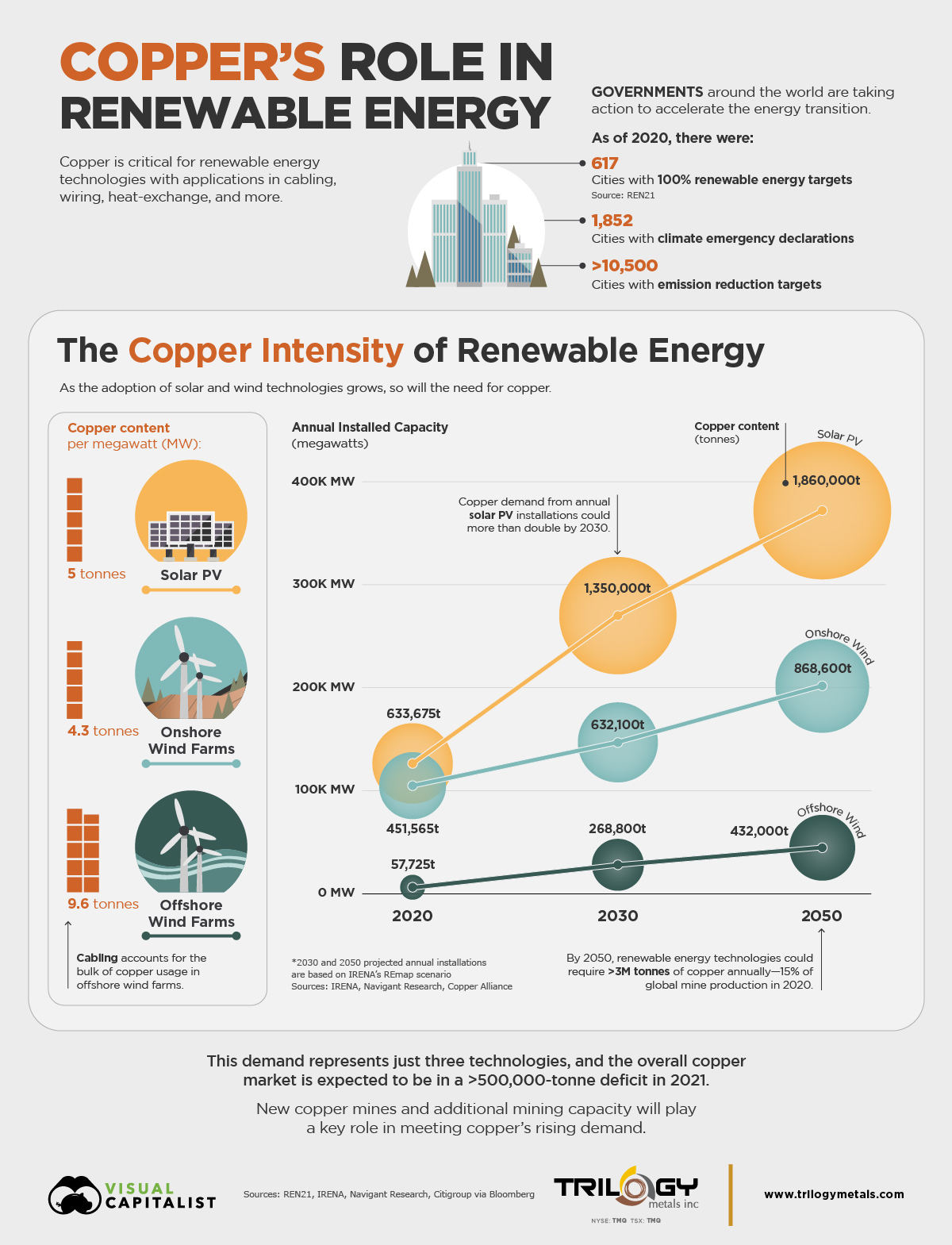
    We featured a recent graphic by Visual Capitalist depicting the Copper intensity of the energy transition with a view towards solar and onshore and offshore wind energy technology:

    8908AEEC-CEA8-4575-91C2-598C427FF705

    Current developments in Washington, D.C., including some of the spending provisions contained in the reconciliation and infrastructure packages, as well as announcements of new EV goals and fuel efficiency standards — will only add to the critical material demand scenarios.  Rising prices for wind-critical materials like Copper, REEs and steel are just one indicator that the only way to moderate the mineral intensity of the low-carbon future is to develop more sources of supply.


    Share
  • “Undoubtedly Good News for Industrial Metals” – a Look at the Senate-passed Infrastructure Package

    In a recent piece for Reuters, columnist Andy Home unpacks the U.S. Senate-passed bipartisan infrastructure package.   While the bill has yet to make it through the U.S. House of Representatives and a likely conference committee, it is worth taking a look at what its passage could mean for the critical minerals sector. According to Home, the [...]
  • The Mineral Intensity of a Carbon-Neutral Future – A Look at Copper

    Amidst the global push towards carbon neutrality, “Critical Minerals” has become a buzzword.  As the green energy transition has gone mainstream and electric vehicles and renewable energy sources dominate the news cycle, so has talk about growing demand for some of the specialized materials underpinning this shift — most notably the Rare Earths, and the battery [...]
  • Copper, Lithium, Antimony and Tellurium: Minerals Make Life Features Four Minerals as “Key to an Advanced Energy Future”

    As the number of countries pledging to reach net-zero carbon emissions by the middle of this century (or soon thereafter) continues to grow, and governments and other stakeholders work to transform the energy systems underpinning our economies, demand for critical metals and minerals is soaring. The rapidly-accelerating adoption of EV battery technology, along with plans [...]
  • DoD Chapter of 100-Day Supply Chain Report Acknowledges Gateway/Co-product Challenge

    Friends of ARPN will know that “much of our work is grounded in a conviction that the Technology Age is driven by a revolution in materials science – a rapidly accelerating effort that is unlocking the potential of scores of metals and minerals long known but seldom utilized in our tools and technologies.” In this [...]
  • Report from The Yukon: Critical Minerals Challenge Brings “Geopolitical Backwater” Into Focus

    As we outlined in our last post, the Biden Administration’s strategy to secure critical mineral supply chains, as outlined in its just-released 100 Day Supply Chain Report, embraces an “all of the above approach.” While strengthening sustainable mining and processing domestically, the Administration will also rely on partnerships with our closest allies — and of [...]
  • The Mining Industry is Ready to Strengthen American Supply Chains

    With the release of its 100-Day Supply Chain Report, the Biden Administration has sent a strong signal that it is serious about stepping up U.S. efforts to secure domestic supply chains — especially for the four areas covered by the report: semiconductor manufacturing and advanced packaging; pharmaceuticals and active pharmaceutical ingredients (APIs), and, of particular [...]
  • DoE Chapter of 100-Day Supply Chain Report Calls for Immediate Investment in “Scaling up a Secure, Diversified Supply Chain for High-Capacity Batteries Here at Home”

    The Biden Administration made clear early on that it is committed to pursuing a low-carbon energy future, and battery technology is a key driver underpinning the shift away from fossil fuels. Just a few weeks ago, when touting his infrastructure package at Ford’s electric vehicle plant in Dearborn, President Joe Biden declared: “The future of [...]
  • Biden Administration 100-Day Supply Chain Report Holds Surprise for Some: And the Winner is… Nickel?

    Critical Minerals policy-wonks:  if you wagered that Rare Earths would be the leading elements in the Biden 100-Day Report in terms of mentions, you’d be wrong. That’s right — we took a look at the Biden Administration’s just-released 100-day supply chain assessment, and created a word cloud based on the number of mentions (footnotes included) of [...]

Archives